How Long Does CBD Stay in a Cat's System & Is It Safe? Our Vet Explains

In this article
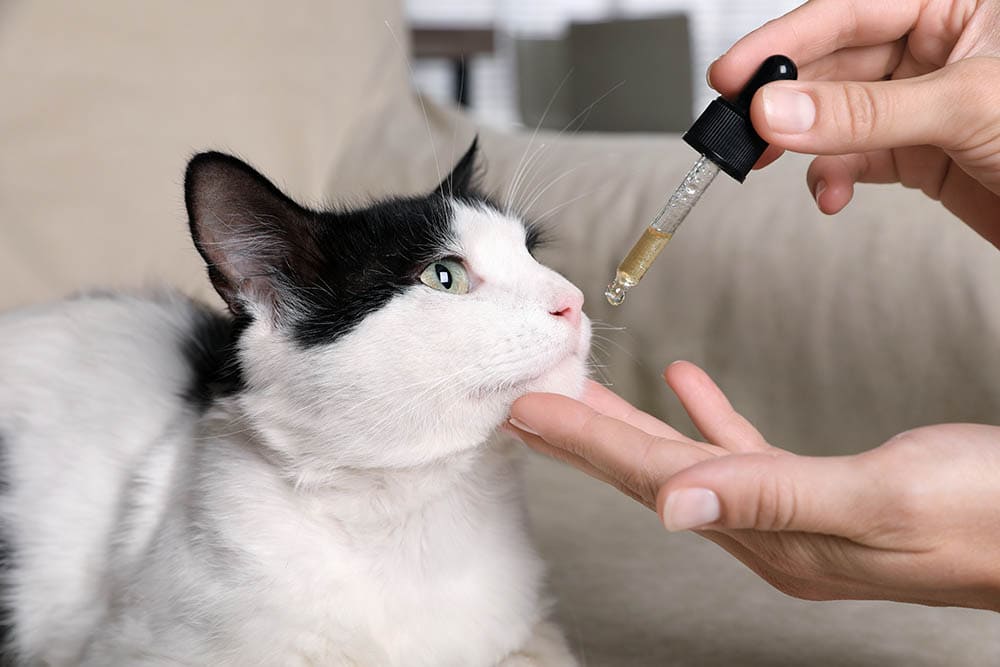
Cannabidiol, also known as CBD, has been growing more and more popular in recent years. It has many benefits for humans, such as managing anxiety and relieving pain, but it can also help cats. It is believed that CBD can help cats with anxiety, arthritis, and appetite stimulation, making it a useful supplement.
If you give CBD to your cat, you should know how long the product will be in their system. Depending on the product type, the route of administration, and the amount administered, CBD will begin to show its effects at varying times. In experiments involving cats, CBD tended to peak in about an hour or two and usually had a half-life of around 2 or more hours.
Read on to learn more about how long cannabidiol (CBD) stays in a cat’s system.

How Long Does CBD Stay in a Cat’s System?
The amount of time that cannabidiol stays in your cat’s system depends mostly on its half-life, which is defined as the time that it takes for half of the dose to be metabolized and removed from your cat’s body and no longer traceable. Most medications need to achieve a certain concentration before their effects can be seen, and these wane once enough of the medicine has been metabolized and removed from the body.
There aren’t as many studies of CBD in cats as compared to dogs. Nonetheless, there are investigations of the half-life of CBD in cats. In a study involving CBD in the form of a paste1, it was found that the product’s half-life was around 2 hours on average. This doesn’t mean that the effects of CBD had stopped at this point, but rather that it had peaked before this time frame and was now being removed from the cat’s body. However, a study involving a concentrated product (oil) showed peak concentrations of CBD in the cat’s system at 2 hours2.
Another case study3 in a feline patient entailed a dose of CBD being administered every 12 hours to help with osteoarthritis pain, indicating that its effects likely wane within 12 hours, so a repeated dose is necessary to help control chronic pain.
Therefore, it can be estimated that CBD likely stays in a cat’s system for several hours, and based on current research, it likely doesn’t last longer than a day or so.

How Much CBD Should I Give to My Cat?
Important
There are no fixed doses for CBD in cats published in any veterinary literature, and current case studies involving cats use different doses depending on the product used and the purpose of the study itself.
Guidelines for CBD doses in dogs cannot be used in cats, as felines seem to appear to absorb or eliminate CBD differently than canines, showing lower serum concentrations and adverse effects of excessive licking and head-shaking during oil administration.
So, if you wish to offer CBD to your cat, you should discuss it first with a veterinarian.

How Long Does It Take for CBD to Take Effect?
Most CBD products used in studies involving cats tended to peak within a few hours of administration, indicating that CBD likely takes effect at around the same time. However, exceptions are likely, especially given the results that different studies have shown so far.
Is CBD Oil Safe for Cats?
CBD oil is believed to be safe for cats up to a certain dose (as determined by experiments4), but a safe dose hasn’t been established for general CBD administration, as some cats show adverse effects with doses that other cats seemingly do not have issues with.
Other studies have shown that harmful contaminants can be found in some CBD products. With that in mind, it is essential to do proper research to determine the safest CBD oil product for your pet.
Conclusion
CBD oil can have benefits for your cat, but studies on its full range of benefits and risks in cats are still not conclusive. Present-day research estimates that CBD peaks within a few hours and likely doesn’t stay for long within a cat’s system.
As research in this field progresses, knowing how long CBD will remain in your cat’s system is an integral part of understanding its potential uses in cats. This information will help veterinarians when it comes to the dosing regimens for the product.
Sources
Featured Image Credit: Kreminska, Shutterstock
Expert cat care, straight to your inbox
Vet-reviewed advice, behavior tips, and the best of Catster. Free, and you can unsubscribe anytime.
By signing up, you agree to our Terms & Conditions and Privacy & Cookies Policy.
Dr. Luqman Javed DVM (Veterinarian)
Dr. Luqman (also known as Dr. Lucky) grew up with an immense passion for animals of all kinds. By becoming a veterinarian, he turned his childhood dream into reality. Now, his goals are focused on providing help to cats all around the world by helping to cat owners understand their feline friends better to ensure the best quality of life for them. His passions are wildlife, exotic pets, pet owner education, and animal welfare. He graduated with his DVM from the Universiti Putra Malaysia in 2020. He has worked with a variety of animal species and has decades of personal experience with keeping many different types of exotic pets, such as turtles, hamsters, freshwater fish, chickens, songbirds, and parrots (and he has extensive skills in training parrots, too).
Join the conversation
Ask a question, share your story, or send private feedback.