Gum Disease in Cats: Our Vet Explains Causes, Signs & Treatments

In this article
No one enjoys being woken up in the morning by a kitty crying for breakfast and attention, but the routine is even less pleasant if a cat has terrible breath. Gum disease is the underlying cause of bad breath or halitosis, but what sort of gum disease can a cat develop, and why does it happen? Can you do anything to prevent it so your nose and ears aren't simultaneously assaulted in the mornings?
Luckily, most gum disease in cats is highly preventable, so let's go over everything you need to know.

Feline Oral Anatomy
To make sure we understand gum disease, it helps to know what constitutes a cat's gums in the first place.
A cat's mouth is the cavity between their lips and their throat. It contains their teeth, tongue, palate (roof of the mouth), jaw, and gums. The gums or gum line is the pink tissue lining the roots of teeth and underlying bone with an inner surface their tongue rests against and an outer surface their lips rest against.
Since the gums line the roots of the teeth, disease between the two is often closely linked.

What Is Gum Disease?
Gum disease is any condition or abnormality of the gums that is negative. In most cases, we mean inflammation, infection, or cancer of some type and source. Gum disease is incredibly common in cats; in fact, up to 90% of cats over the age of 4 may have gum disease 1. Signs of gum disease can overlap between different causes, and treatment is often similar, too. One cause of gum disease almost always leads to other dental or gingival (gum) diseases.
What Are the Signs of Gum Disease in Cats?
The most common signs a cat owner will see at home that indicates a cat may have gum disease will be:
One of the less common causes of gum disease in cats can include tumors, which can look like masses inside the mouth also.
While gum disease is often painful, especially in severe cases, cats may hide the pain for a long time, and the disease usually has to be very significant and progressed before they stop eating. This is important to know because anyone who has had a toothache knows how bad that feels and how impossible it can be to eat like that, so cat owners often rule out dental or gum disease as a problem if a cat is still eating, which is often untrue for these guys.
What Causes Gum Disease in Cats?
Gum disease can come from many sources, like trauma, inflammation, infection, and cancer being the main causes. Let's go over the most important causes to know about.
1. Gingivitis
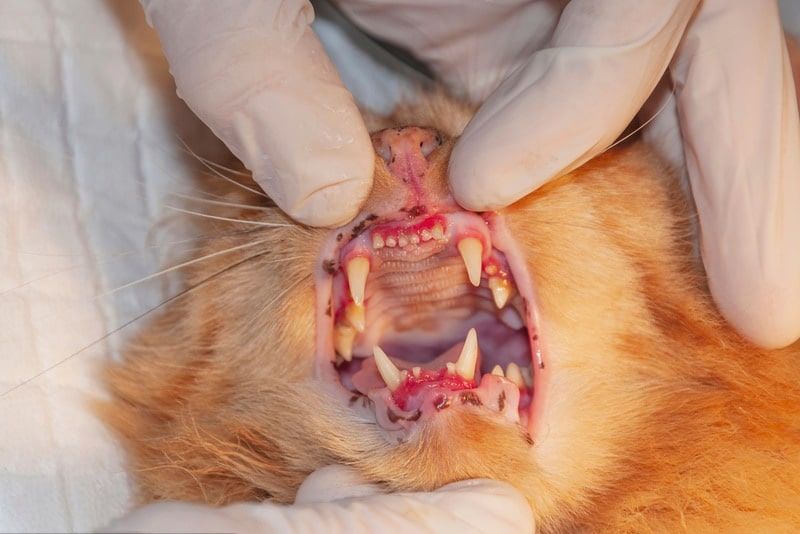
Gingivitis is inflammation of the gum line, which will look like the red lining of the gums along the teeth. It may be present in one spot or throughout the whole mouth and may or may not be painful or associated with other signs or diseases.
A cat's teeth develop a bacterial film known as plaque, which generally starts out as beneficial bacteria that line the tooth enamel and don't go under the gumline. If that plaque overgrows to parts of the tooth that touch the gums, and/or if bad bacteria instead of beneficial bacteria develop, this can trigger a cat's immune system to react on the gum line, which is what gingivitis is, and is why it looks like red, angry tissue.
Once the gums are inflamed, this will generally trigger bad bacteria to replace good ones on the tooth, and this process can progress to periodontitis, in which the tooth is also affected, and the root may die. Tartar or calculus is also the mineralization of plaque. The best way to prevent this is to brush a cat's teeth regularly, and unless the gingivitis is severe, brushing is often also the treatment.

2. Tooth Resorption
Tooth resorption is predominantly a problem for cats. The basics of this disease actually start at the tooth, with a cat's immune system attacking and eating away at layers and parts of a cat's tooth, with different types of resorptions defined by where the process starts. This dental disease almost always triggers inflammation at the gumline as it presents, which is important because, without dental X-rays, the telltale red gums of an affected tooth are usually a veterinarian's (or owner's) first hint that there might be a resorptive lesion on that cat's tooth.
We don't know for sure what causes this, though we know tooth resorption is far more common in house cats than feral cats. Dental X-rays are how doctors confirm the diagnosis, and extraction of an affected tooth is the typical treatment. This allows the adjacent gumline to heal and the inflammation to leave, leaving the cat's mouth far more comfortable going forward.
3. Gingivostomatitis
This special form of gingivitis is far rarer than run-of-the-mill gingivitis. More commonly known as stomatitis, this disease happens when a cat's immune system overreacts to plaque and bacteria on the teeth and mounts an extreme response. For these cats, their gingivitis is usually present through the whole mouth and is so significant that the roots or teeth start to rot, ulcers occur throughout the mouth, including under the tongue, there's usually extreme drooling and even bleeding from the mouth, and their breath will be one of the worst things you've ever smelled.
While biopsies can definitively diagnose stomatitis, the signs are so unique that it's usually enough to diagnose the disease just by looking in the mouth.
This is one of the only times when brushing a cat's teeth is not recommended, and this is because their mouth is so incredibly painful and their immune system is in such overdrive that there's no point; it will just make things worse for their dental pain.
To treat this disease, most cats will need most to all their teeth removed. Without the teeth, there is no plaque film of bacteria for the immune system to react to, and the mouth heals and goes back to being pain-free in most cases.
We don't know why stomatitis happens. There may be some links to genetics, diet, and other diseases like FIV, but we don't have definitive answers about this currently.

4. Oral Tumors
The most common type of oral tumor in cats is squamous cell carcinoma, which makes up about 75% of oral cat tumors. While not nearly as common as other gum diseases like gingivitis, oral tumors are the 4th most common type of cancer seen in cats.
Signs, including bad breath, red gums, or a visible mass, can vary. Of note, trouble swallowing and weight loss are more commonly seen in oral tumors than with other gum diseases (except potentially severe stomatitis cases).
Unfortunately, oral tumors of cats are rarely treatable by the time they are diagnosed. Surgical removal can be done if the tumor is small or isolated enough, but usually, cats with oral tumors would need full jaw resections and other incredibly invasive interventions to remove the tumor, which is just not feasible or in their best interests in most cases.
How Is Gum Disease Diagnosed in Cats?
A thorough oral exam by a veterinarian, potentially paired with dental X-rays, is typically how gum disease is diagnosed in cats. In some cases, biopsies of the gum may also be used to confirm which type of gum disease a cat has.
How Is Gum Disease Treated in Cats?
As you can see above, treatment mostly depends on the specific underlying disease. Removal of plaque buildup through dental cleanings and daily brushing is usually a component of treatment. This can also include removing any diseased teeth that cannot be salvaged. Some diseases like stomatitis may need aggressive treatments like full dental extractions. Others, like squamous cell carcinoma, may not have a treatment option at all.
After diagnosis from a veterinarian, a plan to optimize your cat's dental health will be made that includes treating anything that needs treatment in their mouth.

How Do I Care for a Cat With Gum Disease?
Cats with active gum disease often benefit from switching to wet food, at least temporarily, as it is more comfortable to eat. Soaking their dry food if they refuse wet food is also an option, though cats are so picky about the texture that this is also not tolerated sometimes.
While antibiotics are generally not recommended in most gum disease cases as they don't help as much as you'd think they would, for cats too painful to eat dry food but also refusing any diet changes, pain medications or antibiotics may be prescribed by their veterinarians while awaiting further treatment.
It's important to give these medications exactly as directed, as some pain medications can be hard on a cat's kidneys, and antibiotics cannot be stopped early, or else you risk your cat developing an antibiotic-resistant infection.
Many cats with gum disease will also benefit from brushing their teeth, as long as they aren't too painful for it.
Can Gum Disease Be Prevented in Cats?
Regular brushing of a cat's teeth, especially daily, will prevent most cases of gum disease. Cats, of course, are not always interested in cooperating with this preventative measure, but luckily, there are resources to help cat parents adjust their cats to the procedure.
The basics of teaching a cat to have their teeth brushed are to use a small brush and cat toothpaste (human toothpaste can be toxic to cats in most cases) and slowly introduce steps of tooth brushing one at a time.
Rewarding a cat for letting you touch their head, hold their head, lift a lip, touch a tooth, sniff their toothpaste, lick their toothpaste, let you place some toothpaste on a tooth, let you rub their teeth with a finger, lick or chewing on the brush are ways to progress through the steps until they allow you to brush their teeth.
When brushing a cat's teeth, you only need to worry about the outer side of the teeth, not the inner. If you are in doubt on how to brush your cat's teeth the right way, the easiest thing to do is ask your vet for an advice.
Frequently Asked Questions (FAQ)
How long can a cat live with gum disease?
Cats often chronically live with this condition for years before diagnosis, but without early intervention, this can cause them to lose teeth, lose weight, lead to organ disease or failure from bacterial spread, and can potentially shorten their lifespan.
Can cats recover from gum disease?
It depends on what type of gum disease they have, but very often, yes, they can recover. Uncomplicated gingivitis can be reversed entirely with a dental cleaning and an at-home dental hygiene regimen.
Is gum disease in cats painful?
Cats hide pain as their default, so often, it may not seem like a cat with gum disease is painful. They are usually still eating and drinking, and you may have no clue there's a problem until a veterinarian looks at their teeth, but we know they do still feel dental pain even if they aren't showing outward signs of it.
Conclusion
Gum disease is a common problem for cats over their lifetime, especially for something simple like gingivitis. For most cats, gum disease is preventable and treatable. While brushing a cat's teeth may not sound like any fun, this can go a long way towards preventing future dental disease and early identification of anything that does develop.
Annual physical examinations with a veterinarian also help with tracking gum disease in cats as they age, so be sure they're getting their checkups even if they live inside at all times.
See also:
What Causes Mouth Ulcers in Cats? Our Vet Explains Signs, Causes & Prevention
What Is a Cat Dental Emergency? Health & Care Facts (Vet Answer)
Featured Image Credit: Yaya Photos, Shutterstock
Expert cat care, straight to your inbox
News, insights, and useful advice, delivered to you.

No spam — unsubscribe anytime.
By signing up, you agree to our Terms & Conditions and Privacy & Cookies Policy.
How useful was this post?
Click a star to rate. You can leave written feedback afterwards. (We read all feedback.)
Dr. Maria Zayas, DVM (Veterinarian)
Dr. Zayas is based in Colorado with her dogs, cat, and fish. Dr. Zayas has a strong passion for sharing her extensive knowledge about cats to as many people as possible. With global travel experience, she prioritizes delivering accurate, informative responses to her clients' inquiries. Specializing in house-call veterinary care, she focuses on allergies, pain management, and tailored solutions for cat health care, stemming from a diverse background in shelter medicine and home health. Dr. Zayas holds a Bachelor's degree from Bryn Mawr College and a Doctor of Veterinary Medicine degree from Ross University School of Veterinary Medicine.