What Happens When Cats Fall Out of High Windows? (Vet-Answer)

In this article
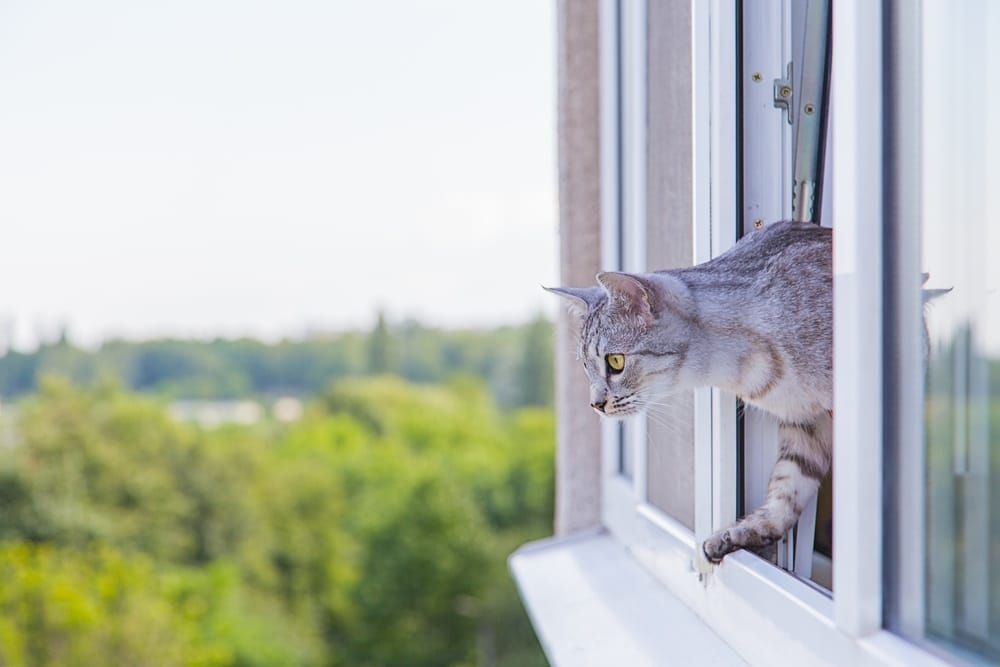
Cats, despite being agile creatures, can fall out of windows by accident. High-rise syndrome, also called falling cat syndrome, is a veterinary term that refers to the group of injuries that cats sustain when they fall from high heights. This tends to be from windows of flats or off balconies. Typically, they fall from a height greater than two stories.
The injuries sustained vary depending on the exact height the cat has fallen and what sort of surface they have landed on as well as the cat's age and general health status. Common injuries sustained include fractured limbs, facial trauma, internal bleeding, and chest trauma.
The severity of the injuries ranges from mild and manageable to fatal.

Clinical Signs of High-Rise Syndrome in Cats
The clinical signs will vary greatly depending on how far your cat has fallen and how hard they have hit the ground. The injuries can be mild and or even non-existent. Unfortunately, they can also be fatal.
A delay in the onset of clinical signs is common. It is very important to take your cat to your vet even if they are not displaying any clinical signs straight after the fall. There still can be issues developing that are very serious but not visible.
Clinical signs may include

Causes of High-Rise Syndrome in Cats
The cause of high-rise syndrome in cats is usually due to the cat falling from a great height over a balcony or out of a window. This commonly happens from the comfort of their own home in surroundings they are familiar with. Elderly cats can often fall if they are unsteady on their paws or become disorientated.
Young kittens can fall due to their inexperience and curiosity getting the better of them. Cats may also end up falling if their predator instincts kick in and they try to chase potential prey.
Common scenarios include
What to Do If Your Cat Has Fallen Out of a Window
Usually, owners will be aware or have strong suspicions that their cat has fallen out of a window or off a balcony as they will not be in the home. Shut any windows or doors to prevent any further falls or injuries. This is especially important if you have a multi-cat household.
If you see your cat fall, whether or not they are displaying clinical signs of an injury afterward, it is vital that they are brought to your vet to get checked out. Extra care must be taken when picking up or attempting to move your cat to ensure that you do not cause further damage.

Common Injuries Sustained When Cats Fall Out of High Windows
1. Chest Injuries
Chest or thoracic injuries can be some of the most serious. They are commonly seen when cats fall from heights. Usually, it is the sheer impact of the fall which jolts and causes damage. Structures such as the ribs, the sternum, the lungs, the heart, and important vessels in the thoracic cavity can be damaged.
The sternum can fracture, and it is very common for the ribs to break. If they do, they can puncture lungs which leads to serious complications.
2. Face Injuries
If the cats do not have an opportunity to correct themselves during the fall, they can often land on their face. Jaw and cheekbone fractures and broken teeth are common in this case.

3. Head Injuries
Again, if the cat struggles to correct themselves during the fall, they can land on their head. The impact of the fall can cause skull fractures, concussion, and bleeding on the brain. This is one of the important reasons you need to take your cat to the vet after a fall even if you cannot visibly see any injuries, as there may be something serious going on internally.
4. Limb Injuries
Depending on the angle of the fall and which part of the cat hits the ground first, fractures can occur. Dislocations, sprains, and strains are seen too but are not as common.
5. Spinal Injuries
Any sort of trauma to the spine can cause serious damage such as fractures or displaced discs. This can result in paralysis.
6. Internal Injuries
Depending on how the cat lands, the impact of the fall can cause injuries to be sustained internally. These can be challenging to diagnose but can be very serious. Common injuries can involve the bladder, liver, spleen, and kidneys. The pelvis can also become fractured.

Treatment of High-Rise Syndrome in Cats
When you arrive at your vet's, they will perform a full physical examination to check for any injuries. Often an ultrasound scan and X-rays are required to assess any internal damage. This can be especially useful for identifying organ damage and free fluid in the abdomen. A blood and urine sample will be taken for analysis too.
Your vet will administer appropriate medical treatment including pain relief. If further steps are required such as fracture repairs this will be planned once your cat has been stabilized. Often cats are in shock if they have sustained an injury and will require oxygen supplementation, intravenous fluid therapy, and pain relief.
Treatment of high-rise syndrome depends on the type of injuries sustained. There are some injuries that require immediate medical attention and others that can be managed less urgently. Pain management is important to make your cat comfortable and alleviate any pain during the recovery process too. Fractures will be treated with external fixation, internal pins, casts, or splints. In very severe cases, amputation may be necessary.
Internal injuries often require surgery to repair or remove damaged organs. Depending on the type of injury, emergency surgery may be required, especially if there is blood, urine, or other fluids leaking into the abdomen. Head injuries will require pain relief and anti-inflammatory medication. Your cat will be closely monitored for any neurological deficits.
If dental injuries have been sustained, broken teeth may need to be extracted or root canal surgery performed. These sorts of procedures will only be carried out once your cat has been stabilized.
When all emergency treatment has been carried out and your cat is stabilized, ongoing supportive care is necessary to ensure a good recovery and allow your cat to be as comfortable as possible. This will include fluid therapy to maintain hydration and achieve electrolyte balance.

Why Do Cats Often Survive After Falling from a High Window?
Surprisingly, cats seem to have an amazing ability to bounce back from falls out of high windows. There are a few very good reasons for this which involve physics, good genetics, and physiology. They are not just using up their nine lives!
Righting Reflex
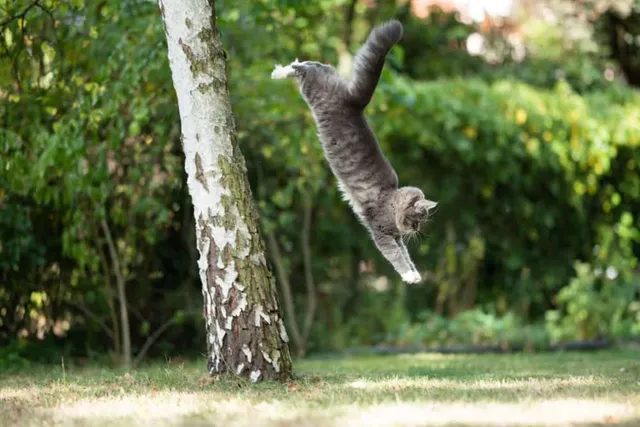
Cats are born with an incredible reflex that enables them to right themselves during a fall, in mid-air. This is down to their flexible spine, their vestibular system, and the organs in their inner ear that enable them to balance so well. They can twist in mid-air, ensuring that they land the right way up, on their four paws. This minimizes impact and distributes the force from the pavement evenly through their body.
This doesn't always happen, but most cats can do this. It does not guarantee a safe landing but makes the likelihood of serious injuries smaller.
Low Terminal Velocity
Another thing cats have in their favor, especially compared to humans, is a low terminal velocity. This is the maximum speed reached during a fall.
Cats are small and weigh less than humans. When they are free-falling, they reach a lower terminal velocity compared to humans or larger animals.
Since they fall at a lower speed, this reduces the overall impact force when they do eventually land. This means the chances of serious injuries are reduced.
Good Flexibility
As mentioned above, cats have very flexible spines and are very agile. They can quickly twist around with ease and flip their bodies around.

How Do I Prevent My Cat from Experiencing High Rise Syndrome?
The good news is that high-rise syndrome can be prevented by taking a few precautions.
Simple Solutions
Conclusion
It will always be a traumatic ordeal for cats and owners if their cat falls out of a high window. The good news is that the prognosis for cats experiencing high-rise syndrome is generally very good. Survival rates exceed 90% in reported studies. The chances of ending up unscathed depend on how high up the window is, how the cat lands, and what they land on. It is always important to have your cat checked out after a fall, even if they appear fine, as there may be some internal damage that isn't obvious.
It is fairly easy to prevent cats from experiencing high-rise syndrome. There are a few simple steps owners can take to ensure their cat doesn't fall out of a window in their home.
Sources
Featured Image Credit: Dmitrij Skorobogatov, Shutterstock
Expert cat care, straight to your inbox
News, insights, and useful advice, delivered to you.

No spam — unsubscribe anytime.
By signing up, you agree to our Terms & Conditions and Privacy & Cookies Policy.
How useful was this post?
Click a star to rate. You can leave written feedback afterwards. (We read all feedback.)
Dr. Emma Chandley, BVM MRCVS (Veterinarian)
Dr. Emma is an experienced vet who is happy to share her expertise and knowledge about cats with readers. Her passion is surgery but she will happily talk about anything animal-related. Dr. Chandley graduated from The Royal Vet College and since then she has worked in general practice in Great Britain. Dr Chandley has completed a postgraduate certificate in Small Animal Surgery and has also gained Advanced Practitioner status in the same discipline. She enjoys developing her skills in animal behavior, nutrition, and clinical pathology as well.