Can a Kitten Survive With a Broken Tail? Our Vet Explains

In this article
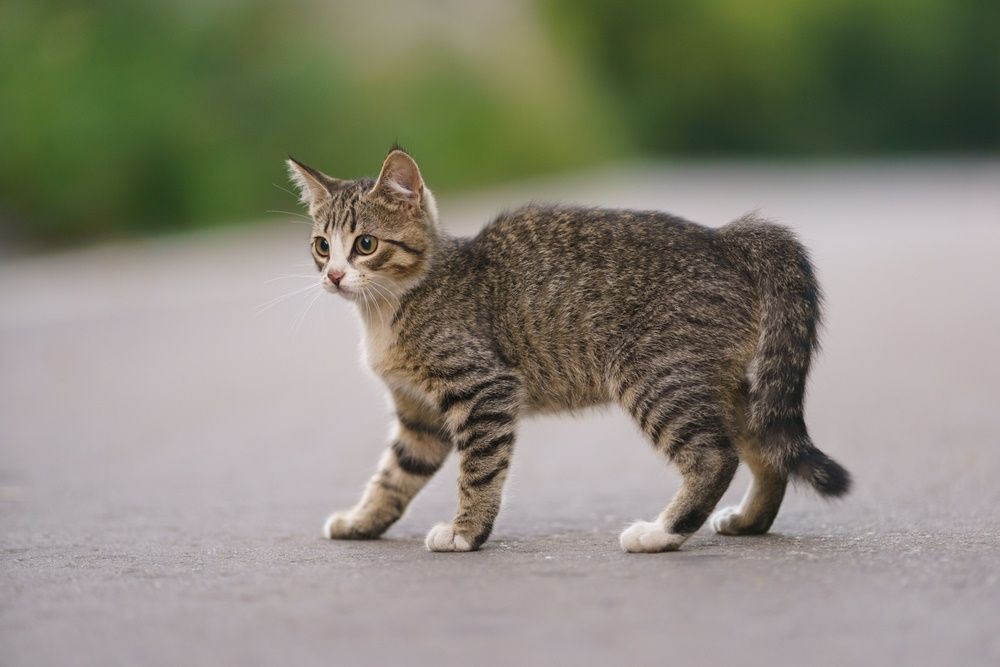
Have you ever seen a cat with a tail that’s wonky or crooked? Chances are, that tail was broken at some point and healed out of alignment, and it’s quite common for this to have occurred when they were very young.
If your kitten has a kink in its tail, you’re probably wondering what needs to be done. In the vast majority of cases, by the time you’ve noticed that your kitten has a broken tail, it has probably already healed. Yes, kittens can survive with broken tails. However, there are times when you need to get them help from a vet, so here is some more information on what to watch out for if your kitten has broken their tail.

Does a Broken Tail Hurt?
Your cat’s tail is made up of a single line of vertebrae held together by muscles, ligaments, and connective tissue. The spinal cord finishes at around the fifth lumbar vertebrae, which is in front of the pelvis, so movement and sensation of the tail come from branches of nerves that grow out from the end of the spinal cord like a ponytail, which thin out and diminish along its length. This area is called the cauda equina, which translates to “horse tail.”
This means that sensation reduces towards the end of the tail, especially in kittens. Because of this, it is not uncommon for kittens to damage or break their tails when they are quite young without noticing anything more than a brief pinch; sometimes, nothing at all. Being so tiny and thin, kitten tails can break quite easily and can even be damaged before or during birth.
If the kink in your kitten’s tail is not painful, it is likely that the injury has already healed, but it is always best to check with a vet to be sure.
Is the Tail Broken or Dislocated?
Most of the time, what seems to be a broken tail is actually just dislocated, with damage to the tissue connecting adjacent vertebrae. Actual bone fractures do occur, but dislocations are more common.

How Do You Treat a Broken Tail?
As you can probably imagine, splinting, strapping, or immobilizing a tail is virtually impossible without immobilizing the whole cat, so how we treat a broken tail depends on the severity and location of the break/dislocation.
Minor Damage
If the fracture/dislocation is not too severe and there is no broken skin, pain relief and rest are usually prescribed until the injury has healed and is pain-free.
Moderate Trauma
If the damage is causing more significant deformation of the tail (e.g., a right-angle bend) or if there are wounds to the skin, a vet will likely recommend admitting your kitty for a sedation or general anesthesia so they can take an X-ray of the damage, suture any deep wounds, and attempt to reduce the fracture to encourage it to heal in the right position.

Major Trauma
In the case of a tail crush injury, contaminated wounds, nerve damage, or degloving (complete loss of the skin), amputation will most likely be the best way to ensure a good recovery.
Although a cat’s tail is important for communication and balance, your cat will cope with the loss very well, and, in most cases, cats feel completely well and back to normal within hours of a tail amputation surgery.
Tail Pull Injury
This might sound innocuous, but a tail pull injury can cause significant problems for a cat. This type of injury often occurs when a cat is hit by a car but can also be sustained if the tail is trapped in a door, caught by a predator, or maliciously pulled.
To understand why this type of injury can be so harmful, we need to think back to the anatomy of the cauda equina, where nerves branch off to supply the tail, hind limbs, bladder, and anus. Depending on how much traction has been applied, a tail pull injury can result in neurological deficits such as:
- Flaccid (paralyzed) tail
- Hind limb weakness or deficits
- Urinary incontinence
- Fecal incontinence
Often, a high-tail amputation is recommended to reduce any further damage that could be caused by a limp tail pulling on the damaged nerves. Anti-inflammatories, pain relief, and rest are vital parts of treating a tail pull injury, and some patients may need help going to the toilet. Nerve function can return, partially or fully, once the swelling and inflammation have settled.
Sadly, many cats with severe tail pull injuries are euthanized, as their incontinence and hind limb deficits lead to poor quality of life.

Frequently Asked Questions
The Tip of My Kitten’s Tail Is at a Funny Angle—Should I Be Worried?
As long as your kitten is otherwise happy, healthy, and playful and the crooked tail isn’t painful, your kitten will likely be just fine and have a unique little feature.
Should I Take My Kitten to the Vet if They Have a Broken Tail?
If in doubt, get them checked out. If you have recently adopted a kitten, it’s always a good idea for them to have a checkup with the vet anyway, so this is the perfect time to get that wonky tail looked at. If they have had a little kink in their tail since you have had them and are not bothered by you touching it, there is likely no cause for concern.
What Sort of Signs Do I Need to Be Watching Out for If My Cat Has a Broken Tail?
If you spot any of these signs, you should make an appointment to see the vet:
- Tail held at a strange angle
- Limp tail
- Swollen tail
- Painful tail
- Any wounds on the tail
- Bleeding
- Toileting problems
Summing Up
Broken or dislocated tails are relatively common in cats and often go unnoticed in kittens. If your new kitten has a painless bump, kink, or crooked bit in their tail, it was probably injured when they were very little. It is impossible to splint or surgically repair a broken tail, so it’s quite common for these injuries to heal a bit crooked, especially if they happen to very young and tiny kittens.
Tail amputations are sometimes needed to treat severe tail injuries, particularly if significant damage or infection is present. The most serious type of broken tail occurs with a tail pull injury, as the resultant damage can affect the nerves that control tail and hind limb sensation and motor function, as well as urinary and fecal control.
The most important signs to look out for if you suspect your cat has injured their tail is pain, swelling, and a limp tail. Although many broken tails require minimal treatment, it is always best to have your kitten examined by a vet to ensure they are not in pain or have any other injuries.
See also: What Causes Limp Tails in Cats?
Sources
Featured Image Credit: YuryKara, Shutterstock
Expert cat care, straight to your inbox
News, insights, and useful advice, delivered to you.

No spam — unsubscribe anytime.
By signing up, you agree to our Terms & Conditions and Privacy & Cookies Policy.
How useful was this post?
Click a star to rate. You can leave written feedback afterwards. (We read all feedback.)
Dr. Karyn Kanowski BVSc MRCVS (Veterinarian)
Dr. Karyn comes from Queensland, Australia, and has lived in the UK for the past 10 years. In 2010, she graduated from The University of Queensland School of Veterinary Science and also has a Bachelor’s degree in Zoology. She is passionate about using evidence, experience, and owner collaboration to provide the best solutions for pets, and believes in making reliable information about animal health accessible to all. Dr. Karyn shares her home with five cats, four dogs, and one husband. When she is not in the scrubs, she spends her time writing, gardening, and cleaning up pet hair!