Get

In Your Inbox

Catster is reader-supported. When you buy via links on our site, we may earn an affiliate commission at no cost to you. Learn more.

How to Clicker Train a Cat: 4 Vet-Approved Steps

Share

cat training

Most people will say that cats are untrainable, but the reality is that they can be trained if you take the right approach. Clicker training can be highly effective with young cats and kittens, giving you the tools to teach basic behaviors or even advanced tricks.

Learn how to clicker train your cat with a simple clicker, a handful of treats, and lots of practice!

divider 3 paws

Before You Start: Get Supplies to Train Your Cat

Here’s what you’ll need to clicker train your cat:
  • A clicker tool or a clicker training app on your phone
  • Healthy cat treats
  • A lot of patience

A clicker is a small plastic box that you hold in your hand. It has a metal tongue that you can press quickly to make a clicking sound. Some cats don’t like how loud clickers are, but you can find soft clickers are less likely to be startling.

clicker for cats and dogs
Image Credit: bmf-foto.de, Shutterstock

divider 3 paws

Step-by-Step Guide to Clicker Train a Cat

1. Introduce the Clicker

The first step with clicker training is building an association between the sound of the click and your cat getting a treat. The key is to deliver the treat immediately after clicking. Use high-value treats like tuna bits or cooked chicken diced into cubes. Eventually, you can work with regular treats.

It takes a lot of consistency and repetition to build this association, but it works if you stick with it. Your cat will learn that the click means a treat is coming, which is when you can use this method to train basic behaviors.


2. Start Behavior Training

Let’s begin with a simple command like “sit.”

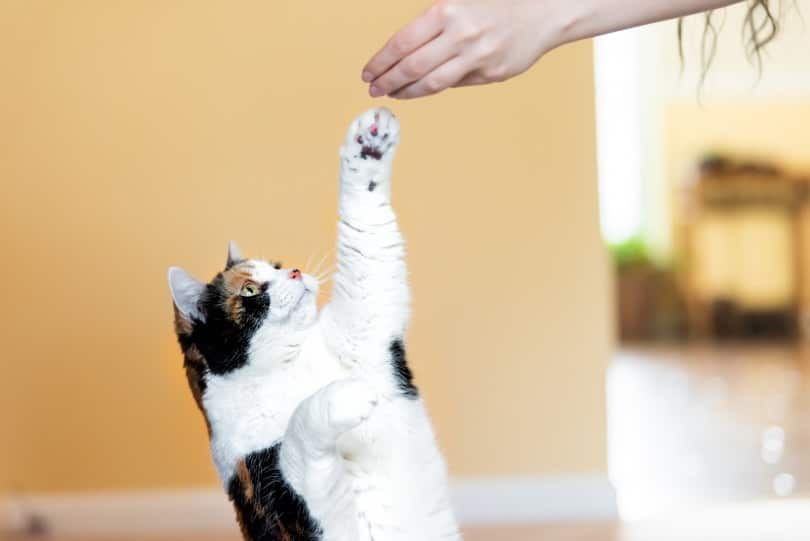
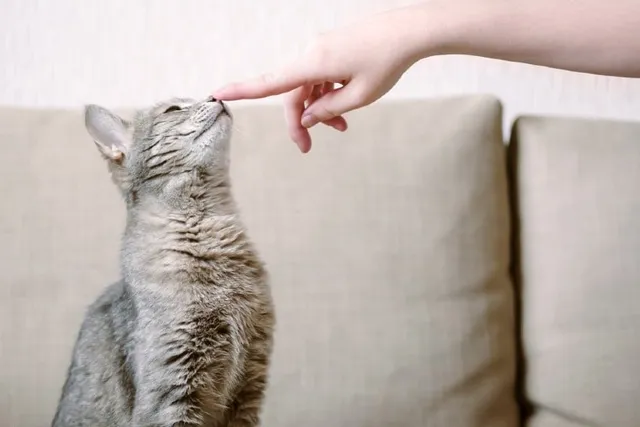
Approach your cat with the clicker in one hand and a treat in the other. Hold the treat up to your cat’s nose. As your cat begins to sniff, move the treat from their nose to just between their ears. Since they will follow with their eyes and nose, they will naturally sit.

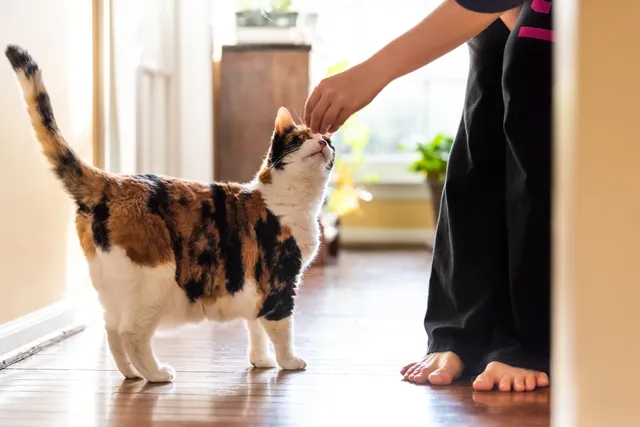
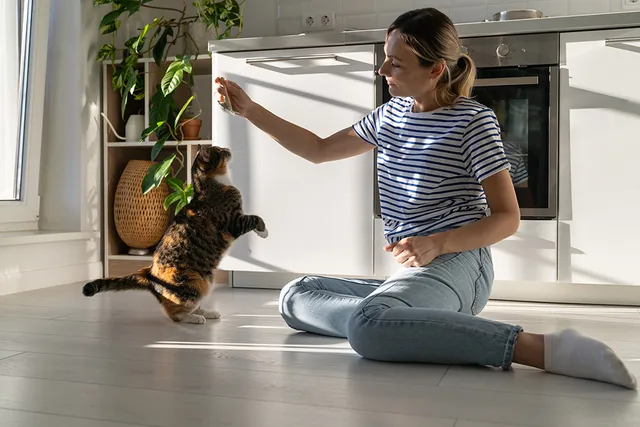
The second your cat’s rear hits the floor, click and offer a treat. It’s crucial that you get the timing just right to build the association between sitting and getting a reward. Practice several times until it becomes reliable. Similar commands can be taught using the same methods, such as target touching, “stay”, or fetch.

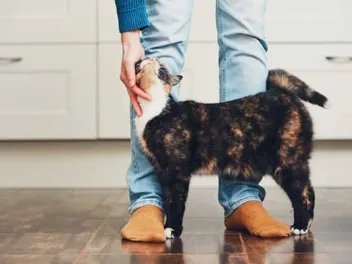
calico cat standing up_Andriy Blokhin, Shutterstock
Image Credit: Andriy Blokhin, Shutterstock

3. Teach Appropriate Behavior

Along with training the basic commands, you can use clicker training to reduce negative behaviors. The key isn’t punishing the bad behavior but redirecting it to something you want the cat to do.

For example, if you wanted to teach your cat not to scratch your couch, it takes not only making the couch an unpleasant thing to scratch but also shifting the impulse to something your cat can scratch, such as a scratching post.

Simple tricks can work to deter the behavior, such as double-sided sticky tape on your couch. Then, ensure that you offer your cat an alternative scratching area to use instead. When your cat scratches the scratching post or mat, use a click and treat as a reward.


4. Don’t Do Too Much Too Fast

A cat that isn’t responding to training may simply not understand what you’re expecting from them. Trying to accomplish too much at once, especially in an older cat or a cat that has some negative associations, is a recipe for setbacks.

Make the rewards enticing and easily accessible to build up to more complex behaviors. Ensure that you only train one new behavior at a time and that each is trained in small steps so the cat can realistically progress from the basis. For example, if you wish to teach your cat to pass through a tunnel, be sure the cat is confident outside and around the tunnel before you expect them to cross it. Let them build their confidence, and reinforce every small progress with the treat.

The first treat should come when they look inside the tunnel; the clicker is used to mark that exact moment. When they put their head in, use the clicker again, followed by a treat to let the cat know that that’s right. The third click plus treat will be achieved for entering the tunnel until at least the base of the neck, the fourth for stepping one paw in, and so on. This should be achieved in several sessions to enable the cat to end each on a positive note.

kitten training
Image By: Jaromir Chalabala, Shutterstock

divider 3 paws

Conclusion

No matter your cat’s age or breed, you can train them to learn basic commands and tricks with clicker training. It’s also a great option to reduce unwanted behaviors in a positive way and alleviate any fears or stress your cat had in the past with punishment. Whatever your goals, regular training sessions, a clear plan with small achievable steps, and consistency are the secret formulas for success.

Sources

Featured Image Credit: Andriy Blokhin, Shutterstock

Want content like this delivered to you?

Sign Up For Our Newsletter

News, insights, expert advice, and everything cat

* By submitting, you agree to our Terms & Conditions and Privacy & Cookies Policy.


How useful was this post?

Click on a star to rate (you can leave written feedback after clicking submit)

Help us improve Catster for pet parents!

Your feedback really matters.

What did you like about this post? Also how can we improve it?

Join the conversation

Leave a Reply

You’re very welcome to leave a comment or question. Please know that all comments must meet our community guidelines, and your email address will NOT be published. Let’s have a positive and constructive conversation.


Talk With A Vet Online

Peace of mind,
anywhere, anytime

Affordable vet advice

Why Is My Cat Breathing Fast? 5 Reasons Behind This (Vet Answer)

A cat that seems to be breathing faster than usual is always alarming and should be checked by your vet straight away. After...

Why Does a Comb Make a Cat Gag? Vet-Reviewed Facts & FAQ

Maybe you have seen the videos online or experienced this yourself at home: you flick the teeth of a comb, and your cat...

Who Will Take Care of My Cat When I Die? Here’s How It Works

As a pet parent, it’s critical to ensure your cats are properly cared for if something happens to you. There are a few...

Can Cats Drink Lemonade? Vet Reviewed Health Risks & FAQ

When summer hits, it’s not uncommon to have a pitcher of lemonade sitting around with which to cool off. Lemonade makes the perfect...

More related

Skin Disease in Cats: Our Vet Explains Causes, Signs & Treatments

Skin disease in cats is incredibly common. Cat’s skin plays an important role, and it is the largest organ in your cat’s body....

Kong Cat Zoom Groom Review 2026: Pros, Cons & Verdict

Review Summary Kong is one of the best-known pet product manufacturers out there. It’s perhaps best known for its line of stuffable dog...

15 Cats of Instagram to Follow in 2026: Top Accounts & Influencers

Cats have been adored by humans for millennia, so it’s no surprise that many cats have become famous internet icons. Some cats have...

Can Cats Eat Frosty Paws? Vet-Reviewed Nutritional Facts & FAQ

When it comes to our pets, we often want to share delicious treats with them. For multi-pet households, keeping up with your pets’...

Keep reading

Mouth Cancer in Cats: Vet-Reviewed Signs & When to Euthanize

One of the most difficult parts of pet ownership is making end-of-life decisions. Knowing when to euthanize a beloved animal companion is never easy, and there’s no right answer for every situation. Personally, I’ve had to make that choice three...

cat mouth check by vet

Why Do Cats Like Watching Other Animals? Vet-Reviewed Feline Behavior

Cats spend a good portion of their day observing their environment. Other animals are of particular interest for felines, whether it is a dog or bird they spotted from the window. Although cats may watch other animals because they simply...

cat-watching-birds-in-the-window

Does Hot Water Kill Fleas on Cats? Vet-Approved Facts & FAQ

Having a cat in your life is wonderful, but it sometimes comes with a catch: dealing with fleas. Apart from being annoying, flea infestations can trigger allergies, irritation, and even illness. So, getting rid of them as quickly as possible...

woman bathing her cat

Why Is My Cat Suddenly Walking Like They’re Drunk? 10 Vet-Reviewed Reasons

It’s a question that concerned cat owners may ask: Why is my cat suddenly walking like they’re drunk? There are many possible reasons for this, and we will discuss some of them below. Cats can become unsteady on their feet...

orange cat shaking its tail

8 Vet-Reviewed Common Cat Ear Problems & How to Treat Them

Who doesn’t love cat ears? They’re adorable and hilariously expressive! As charming as a pair of kitty ears can be, they can also cause your pet pain and discomfort when something is wrong. Ear problems in cats aren’t an everyday...

vet checking the ears if white cat

Cat Peeing in Front of the Litter Box? 14 Vet-Reviewed Solutions to Try

Discovering a little puddle of cat pee in front of the litter box can be frustrating, but your cat is not doing this on purpose! When we dig deeper into the reasons that cats pee in front of, instead of...

Bengal cat sitting aside of a litter box staring at it

Does Coconut Oil Kill Fleas on Cats? Vet-Reviewed Effectiveness & Safety Guide

While fleas are tiny parasites, a flea infestation can quickly wreak havoc and take over your entire home. If you do a quick online search, you can find many natural home remedies that claim to be effective in getting rid...

coconut-and-coconut-oil-with-coconut-tree-background

Can Cats Eat Limes? Vet Approved Facts & FAQ

Our feelings about our pets have changed. Many people see themselves as parents instead of owners. That’s reflected in the fact that some manufacturers label their products as human-grade, although no legal framework for this term exists; it’s simply marketing....

Can Cats Eat Limes

Love Cats? So Do We! Join the Catster Community

Stay informed with expert pet care insights delivered straight to your inbox! Discover professional guidance on animal behavior, feeding tips, trusted product picks, and much more.


Sign up for the Catster Email Newsletter

Stay informed with expert pet care insights delivered straight to your inbox! Discover professional guidance on animal behavior, feeding tips, trusted product picks, and much more.