


It’s a common myth that cats always use their litter boxes without issue. For the most part, cats indeed learn to use a litter box rather quickly, but this doesn’t mean that you’ll never encounter problems with your cat going potty outside the litter box or, worse yet, going in undesirable places, such as your bed or other pieces of furniture.
When a cat goes potty outside the litter box, it’s not an act of misbehaving or trying to annoy you. Your cat is trying to tell you something, and the reasons for the behavior vary from an unclean litter box to a medical issue. Come with us to learn eight common litter box issues and how to fix them.

The 8 Common Litter Box Issues & How to Fix Them
1. Possible Medical Issue
We wanted to list this possibility first because having your cat checked out by your vet should be the first step in figuring out the problem. A few medical factors could be the culprit for your cat having litter box issues. Let’s take a look.
Urinary Tract Infection
Urinary tract infections (UTIs) in cats are not routine but can occur. Cats with a UTI may urinate outside the litter box, which is a huge red flag. Cats with UTIs may also urinate very little in the box, or they may even cry out in pain while trying to urinate. There may even be blood in the urine. Another sign of a possible UTI is if your cat frequently licks their rear end. If your cat displays any of these signs, take them to the vet for an examination.
Feline Interstitial Cystitis
Feline interstitial cystitis, also called feline idiopathic cystitis, is a medical term used to describe inflammation of the bladder. It’s a diagnosis used when no other causes or clinical signs can be identified. Previously called IFLUTD (idiopathic feline lower urinary tract disease), it’s most common in young to middle-aged cats. Common signs of the condition are bloody or discolored urine, straining to urinate, frequent urination, and urinating outside the litter box.
Bladder Stones/Bladder Crystals
Bladder and kidney stones can cause your cat a great deal of problems. These stones are a collection of crystals, minerals, and organic matter that can be brought on by a disease or a type of inflammation. They can block the urethra, making it difficult or even impossible to urinate, and one sign is urinating in unusual places and not the litter box. If your cat cannot urinate, this is a medical emergency.

2. Unclean Litter Box
It’s vital to keep the litter box clean for your cat’s sanitary use. If it hasn’t been scooped or replaced with fresh litter, your cat may choose to avoid the box altogether and go potty elsewhere. Most cat owners prefer clumping litter for easy scooping, so if you’re not using it, you may want to consider it for easier cleaning.
You should also thoroughly clean the entire litter box once a week with a mild soap or a diluted vinegar solution (do not use bleach or ammonia). Scrub the box and rise completely before adding new litter for your cat’s use.
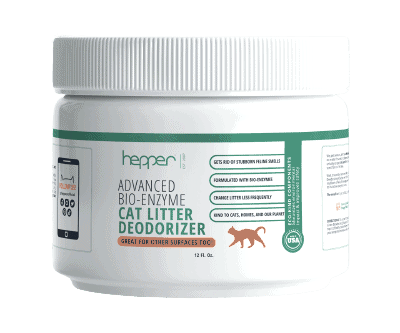
Cleaning up after our pets is not the most enjoyable part of owning them. Despite keeping a clean litterbox, cat odors and stains may still exist around the house. Sometimes, even the best litter box setup needs extra help. If you're tired of dealing with bad smells from litter boxes, Hepper Advanced Bio-Enzyme Pet Stain & Odor Eliminator Spray can help with the worst pet stains and smells. Additionally, the Advanced Bio-Enzyme Cat Litter Deodorizer neutralizes odors upon contact.
Our Favorite Products
| Image | Product | Details | |
|---|---|---|---|
Best Enzyme Cleaner

|
Hepper Advanced Bio-Enzyme Pet Stain & Odor Eliminator Spray |
|
CHECK PRICE |
Best Litter Additive
|
Advanced Bio-Enzyme Cat Litter Deodorizer |
|
CHECK PRICE |
At Catster, we’ve admired Hepper for many years and decided to take a controlling ownership interest so that we could benefit from the outstanding designs of this cool cat company!
3. Not Enough Litter Boxes
In a multi-cat household, you’ll absolutely need more than one litter box; otherwise, your cats may not use the box at all. A rule of thumb is to have one litter box per cat plus one extra. For example, if you have two cats, you’ll need three litter boxes. If you have a multi-level home, try placing a litter box on each level.
Some cats prefer to defecate in one box and urinate in the other, so ensure you do not place the boxes next to each other.

4. Bad Location
Cats are reserved beings and prefer going potty in private. If the litter box is placed in a busy location in the home, your cat may avoid the litter box and choose to go elsewhere. Cats will also seek out an area to go potty with multiple escape routes, which is a trait they inherited from their wild cousins, and placing the litter boxes in an area where your cat feels comfortable will help eliminate avoidance of the litter box itself.
5. Litter Preference
The type of litter you’re using may not be a litter your cat fancies. Cats are sensitive to chemical smells, and some litter may have this odor. Studies show that cats prefer unscented, clumping litter with a sand consistency, and if you’re not using this type, consider switching.
Speaking of switching, if you recently changed litters, your cat simply may not be fond of the new product. It may take time to find an appropriate litter for your cat, but once you do, do not deviate from it if possible.

6. Wrong Size/Shape of Litter Box
Sometimes, the shape and size of the litter box itself may be an issue, especially if you have a geriatric cat. Avoid litter boxes with hoods, as many cats prefer the litter box to be open so they have plenty of room to maneuver around. Hoods also trap odor and may cause your cat to avoid it. Hoods also prevent cats from standing erect while going potty, which most cats prefer. Avoiding litter boxes with high walls is also advisable for senior or overweight cats.
7. Household Stress/Bullying
Suppose you have multiple cats in the home. In that case, one may be bullying another, which can cause litter box issues. Moving to a new home or a new addition to the family, whether a human or another animal, can also cause litter box issues.
How to Remedy a Bullying Problem: Separate the cats and try reintroducing them slowly. Territorial issues are a common reason why bullying happens in the first place, and separating the cats for a period of time may help. Ensure you share your attention and enrichment with all cats in the home, and if your cats are not spayed/neutered, consider having the procedure done.
8. Negative Associations/Stress
Some cats will remember a negative event associated with the litter box. For example, if your cat had a medical issue in the past, like a UTI, the painful memory may keep your cat from using the litter box. The memory of painful waste elimination may resurface, even if your cat is back to good health.
What to Do if Your Cat Avoids the Litter Box
First and foremost, do not punish your cat if they’re experiencing litter box issues, such as rubbing the nose in the urine or feces. Remember that cats are not avoiding the box to annoy you. There is a reason for the behavior, and it’s likely one of the reasons mentioned above.
After visiting your vet to rule out medical issues, here are more tips:
- Avoid placing the litter box close to where your cat eats.
- Do not confine your cat to a small room with a litter box.
- Place toys and treats near the litter box.
- Use an enzymatic cleaner to clean up urine and feces. Enzymatic cleaners contain enzymes that destroy bacteria and eliminate the odor so that your cat won’t repeat the behavior in the same place.
- Do not carry or drag your cat to the litter box, as this will only cause a negative association.
Conclusion
Some cats avoid the litter box for various reasons, but it’s important to rule out a possible medical problem first. Once your cat is clear from a medical issue, you can then start a process of elimination. Remember to evaluate the type of litter you’re using, the location of the box, the style of the, and the number of boxes you have. Ensure you scoop the litter box daily and replace the scooped area with fresh litter. Clean the entire box once a week with mild soap and water or diluted vinegar, and don’t forget to rinse it and dry it completely before refilling it with litter!
Related Reads:
- Cat Litter Box Tips: 9 Vet-Approved Ideas For Placement, Cleaning & More
- 8 Cat Litter Box Tips to Promote Healthy Habits (Vet Verified)
Featured Image Credit: jamesjoong, Shutterstock
 The 8 Common Litter Box Issues & How to Fix Them







4 Responses
I have 2 male, brother fixed cats. Lately the one has been deficating outside his litter box but only sometimes not all the time. He usually does his business at the front of the box and sometimes the feces goes outside the box or on the rim. Both he and his brother are overweight. The other day there was feces on the rim and just outside the box and some in the hallway. His brother goes more in the back of the box and when he dedicates he digs and kicks alot of lottery out. I am at a loss on what to do with them especially the one that is deficating outside the box. Any suggestions?
Hi Lisa, if you are sure that the issue is mainly behavioral, you could try introducing a second litter box, and perhaps a covered one would be ideal to avoid the cat missing it or kicking the litter outside. However, ruling out possible medical problems is a must. Keep an eye on the feces frequency and consistency to ensure it is not a case of digestive problems. If your cats are overweight, arthritis is also a possibility that may be behind their avoiding the box. It is best to get them checked by the veterinarian before investing in new litterboxes, especially if there is a chance they won’t use them. We hope this helps.
I have an older cat who sometimes doesn’t use his box for #2!!! He’s almost 15 years old and this has been going on for a couple years now. He’s been to the vet and has a couple issues, but nothing that would keep him from using the box. I never get angry with him and always speak gently when he has an ‘oopsie!’ He’s a Maine Coon and I think he may be experiencing arthritis or perhaps HD. I purchased a larger box with lower sides and this helps quite a bit. When he makes a mistake, he looks at me with those huge soulful eyes and my heart melts. He’s my sweet baby and I deal with it. Tried so many litter brands and like most cats, he prefers the unscented ones. Hopefully one day, he will learn to love the box again!
Hi Erica M., Thanks for sharing your Maine Coon cat’s story and for your proactive and compassionate approach. A veterinarian should be able to confirm if your cat is suffering from arthritis or hip dysplasia, they could also help your Maine Coon with treatment, although some conditions are not curable, pain management is viable and oftentimes the diseases' progression can often be slowed down with appropriate diet and supplementations. Best wishes.