Cat Colors: Vet-Verified Facts Behind Different Coat Types & Patterns


In this article
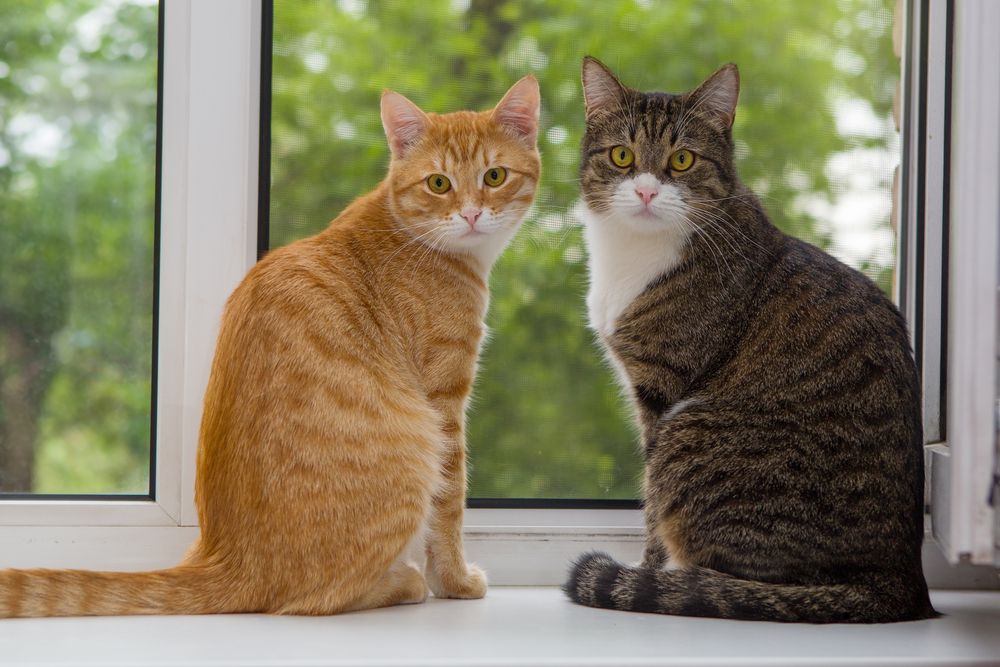
Cats are found in a wide range of coat types, colors, and patterns. Although these different coat types could be breed-dependent, they do not necessarily refer to a specific cat breed.
Some cats have short coats and are only one color, others have elaborate patterns, and some are hairless. While certain coat types are rare and highly sought after, others are common in most parts of the world. Cats have numerous impressive coat variations, and breeders continue working hard to create more.
This article will discuss the facts behind different cat coat colors and patterns.

Different Types of Cat Coats

Before diving into the different cat coat colors and patterns, let’s briefly discuss their coat lengths and textures.
Types of Cat Coat Lengths:
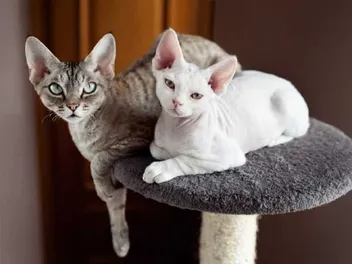
- Hairless: Not all cats sport a luscious coat and can have a hairless body instead. They make up for their lack of thick hair with a fine covering of fuzz over their bodies.
- Short hair: This is a common coat length in felines. Shorthaired cats are generally easy to groom, and their coat gives them a uniform appearance.
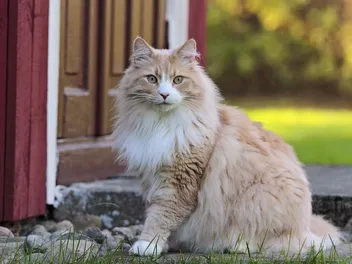
- Long hair: Cats can have noticeably long coat hair that looks impressive with striking patterns. Longhaired cats have more demanding grooming requirements and require regular brushing.
Types of Cat Coat Textures:
- Curly coat: Some cat breeds, like Rex cats, have soft, curly hair with no guard hairs. They can have various coat lengths and curl types.
- Wirehair: Wirehaired cats have coarse, wiry coats with a rough texture.
- Double coat: Cats with a double coat have a long, coarse outer coat and thick undercoat. Both shorthaired and longhaired cats can have a double coat.
Different Types of Cat Coat Colors and Patterns

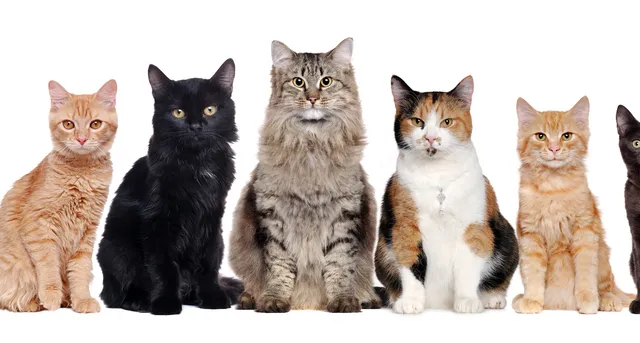
Cats can have numerous coat colors ranging from black, white, gray/blue, cream, cinnamon, chocolate, orange, lilac, and fawn. These coat colors are generally grouped in solid, tabby, bicolored, calico, tortoiseshell, and colorpoint patterns.
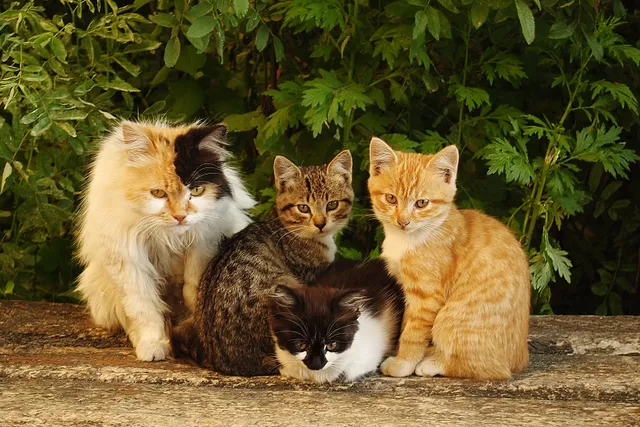
Cats with a solid coat have one distinctive color that covers their entire body, such as an entirely black cat. Bicolored cats have two solid coat colors in easily distinguishable patches. Particolored cats have more than one coat color, such as in calico and tortoiseshell cats.
Solid Coat Colors
1. Black

Black is the most common coat coloration for numerous domestic cat breeds. However, it's rare to find an entirely black cat as their whiskers or paw pads are usually a different color.
For a cat to have a solid black coat, they need to have a copy of the dominant gene that controls the amount of black pigment, called eumelanin, to make the fur look black. A cat breed that is solid black is the Bombay. This pigment also affects their eye color. Most black cats will have gold, copper, or green irises.
2. Chocolate (Brown)

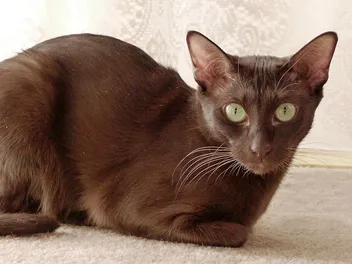
The chocolate coat pattern is rare in cats, but you can usually see patterned cats with some brown fur, as seen in tabby cats. But a solid brown cat is quite rare. To have a solid chocolate or brown coat, the cat must have two copies of the brown gene variant (two allele b or allele b and b1). A handful of breeds can be a solid brown color, such as the Havana Brown, the Burmese, and the Oriental Shorthair.
3. Cinnamon (Light brown)

Cinnamon is an uncommon coat coloration caused by two recessive alleles for the brown gene variant (b1/b1). The cinnamon color appears light brown with hints of gold or orange. Cat breeds like the Oriental Shorthair, British Shorthair, and Ocicat can have cinnamon coats. A solid cinnamon-colored cat is even rarer than a solid chocolate-colored cat.
4. Orange (Ginger)

Orange cats (commonly known as ginger cats) get their color due to the X chromosome. For a female (XX) to get the “ginger gene”, they would need both of their X chromosomes to carry it, whereas a male (XY) only needs one X chromosome to have an orange coat. This means most of the red cats you see are male.
And you will never see a fully orange-coated cat. Instead, you will see patterned cats spotting an orange and usually white coat. Some examples of cat breeds with orange patterns are the British Shorthair and the Abyssinian.
5. White

Some might argue that “white” is not a color but a lack thereof. However, it is still important to have it on this list. Solid white cats have one or two copies of the dominant white gene. Approximately 75% of cats with two copies are deaf, and if only one copy is present, 60% are deaf or have some form of hearing impairment. White cats often have blue or amber eyes or one eye of each color. Turkish Angoras and Persians are breeds that can sport a close-to-solid white coat.
6. Blue (Gray)

Another common coat color for cats is gray, which is a dilution of the black coloration. You can see the gray coloration on several patterns, like the tuxedo and the tabby. But a few cat breeds can have solid gray coats, such as the Russian Blue, the Nebelung, and the Korat.
7. Cream

The dilution of orange fur creates cats with a cream color. For the cream coloration to be prominent, the cat must have the dominant allele of the red gene (O) and the recessive allele of the dilute pigment gene (d/d). A good example of a breed that has a cream coat is the Turkish Van.
8. Fawn

This coloration is a dilution of the cinnamon or light brown coat, so you can imagine how rare it is to see a solid-colored fawn cat! To get this coloration, both parents need to carry the cinnamon color gene (b1/b1) plus two identical alleles to cause the dilution. Like the rarer colorations, it is more common to see fawn fur on cats with patterns, like the Oriental Shorthair.
9. Lilac

Like the fawn color, lilac is a diluted brown coloration, specifically chocolate brown. And like the fawn color, the cat needs to have the recessive allele primary coat color and the recessive allele to dilute the brown. The chocolate color has a bit more black coloration, giving the coat a slight purple tint (hence the name!). British Shorthairs and Burmese cats can have lilac coats.
Cat Coat Patterns

1. Bicolored

Bicolor cats have white plus another color. Three common bicolored patterns are tuxedo, harlequin, and van.
Cats with a tuxedo coat are bicolored and have black and white patterning. Most tuxedo cats' coats are black with white markings, making it appear as if they are wearing formal attire. These white markings usually cover their neck, chest, and parts of their face. Various cat breeds can sport a tuxedo coat, including the Domestic shorthair, British shorthair, and American shorthair.
Harlequin-coated cats are bicolored with predominantly white fur. The rest of their fur has patches of solid colors, such as red, brown, cream, black, and grey. Their tails are a solid color, which matches the color of their patches. Although many cat breeds can have a harlequin coat, it is commonly seen in Persians, Japanese Bobtails, and Turkish Vans. Harlequin cats can be either bicolored or tricolored, but white is generally the dominant coat color.
Van-patterned cats are bicolored, and about 75% or more of their bodies are white. Their primarily white bodies result from the piebald or white spotting gene. They have colorful ears and tails, usually with a white stripe separating the colors on their ears.
It’s not unusual for some van-patterned cats to have small, colorful patches just before the base of their tails. These colors can range from red, blue, and black. However, the original coloration for van-patterned cats' extremities was auburn. This coat pattern is seen in the Turkish Van cat breed.
2. Tabby (Striped)

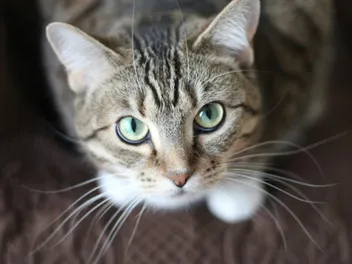
Tabby cats are characterized by the “M” shaped markings on their foreheads. They are not a specific cat breed, as tabby refers to a coat type. Tabby cats can have different coat patterns and colorings, such as classic, mackerel, spotted, and ticked. Agouti hairs are responsible for the light and dark-pigmented bands of a tabby cat's coat.
Most domestic cat breeds carry the tabby locus as it is a common coat type of their ancestors, the African and European wildcat.
3. Tortoiseshell

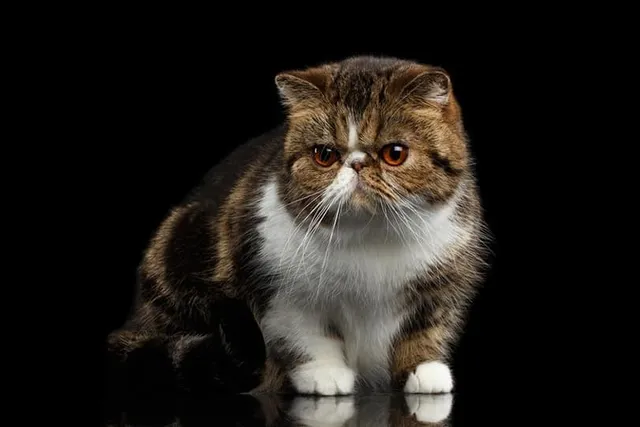
Tortoiseshell patterns are sex-linked, with most tortoiseshell cats being female. Their coats consist of two colors, with one being red and the other one black. However, the red in their coat appears orange tabby, while the black looks chocolate. These colors can be mixed in a bridled or patched pattern.
The bridled pattern makes their coloration look mottled together in small patches, whereas the patched pattern creates larger and more distinguishable patches.
Torbie is the name for cats with a tortoiseshell tabby coat, which are sometimes called patched tabbies. Torbie cats have a combination of tabby stripes, spots, or ticked fur. They are tricolored cats with white, red (orange), and black colored coats. Orange is usually a dominant color, and their stripes are usually the darkest part of their coat. As with calico and tortoiseshell cats, torbies are mostly female as this coat type is sex-linked. Various cat breeds can have the rare torbie coat.
4. Calico

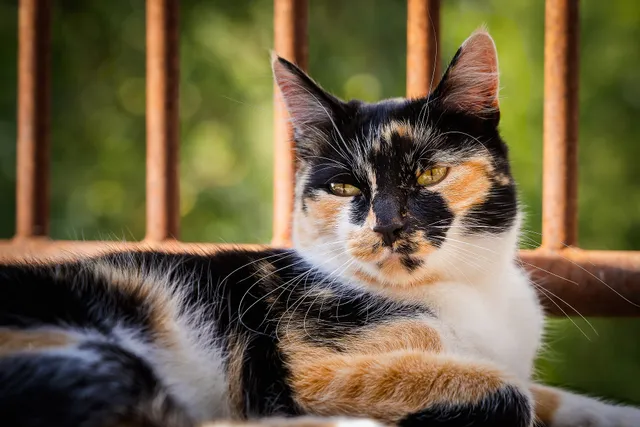
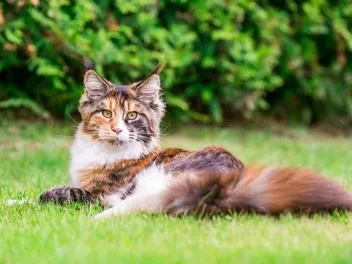
Calico cats are characterized by their tricolored coats and tendency to always be female. The X chromosome is responsible for their unique coat pattern, a mixture of orange, black, and white. Generally, calico cats are considered to be tortoiseshell cats with piebalding.
For cats to have a calico coat pattern, one X chromosome should carry the orange gene and the other the black gene. It is rare for calico cats to be male, and they are rarely fertile. The few existing male calico cats have a genetic abnormality known as Klinefelter syndrome.
5. Colorpoint

The colorpoint coat is caused by mutations in the color gene that cause pigment production sensitive to temperature. This coat is mostly seen in Siamese, Himalayan, Burmese, and Tonkinese cat breeds.
Colorpoint cats will have lighter-colored coats on the warmer parts of their bodies, while their extremities, like their face, ears, paws, and tail, are darker. The enzyme tyrosinase is responsible for temperature-sensitive coat coloration.
Cats with a seal point coat have an ivory coloration combined with black or brown points. These dark points are seen on their faces, ears, tails, and paws. It is a well-known colorpoint coat type in cats, hence why the darker hair is on their extremities. Himalayans, Ragdolls, and Birman cat breeds commonly have seal point coats.
Final Thoughts
There are so many fascinating cat coat colors and patterns. Most cat breeds can have several different coat colors and patterns with various coat lengths. There are only a few breed-specific coat patterns, such as the van-patterning in Turkish Van cats or the rosette markings in Bengals. Many cat coat patterns can be different colors, further proving how diverse cat coat types are.
Sources
Featured Image Credit: Okssi, Shutterstock
Expert cat care, straight to your inbox
News, insights, and useful advice, delivered to you.

No spam — unsubscribe anytime.
By signing up, you agree to our Terms & Conditions and Privacy & Cookies Policy.
How useful was this post?
Click a star to rate. You can leave written feedback afterwards. (We read all feedback.)
Sarah Psaradelis is an avid young writer with dual passions for literature and animals. She enjoys sharing knowledge of animal care and helping others. Sarah has over 8 years of writing experience and is currently studying veterinary science. She resides in South Africa where she takes care of fish, aquarium snails, dogs, and rodents. Sarah is a passionate vegan activist and animal rescuer pursuing her path to make the world a better place for humans and animals alike.