10 Facts About Cats' Eyes: Vet Verified


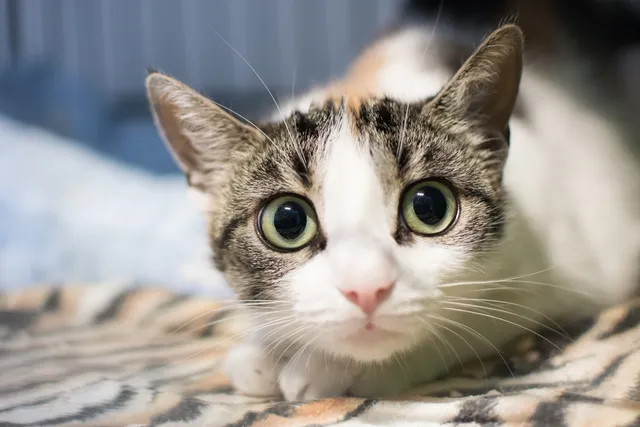
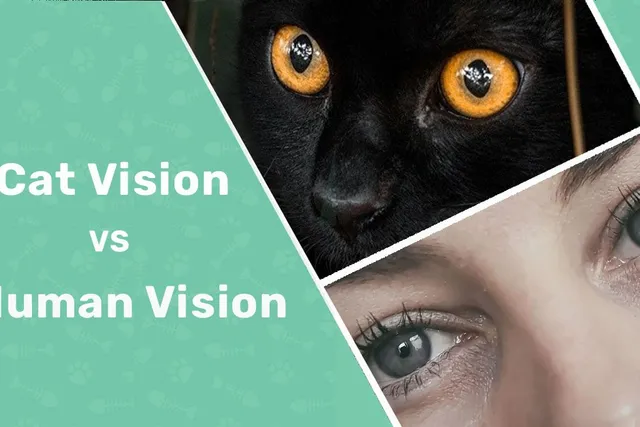
We sometimes wonder if our cats see the world the same way we do. Are cats’ eyes similar to humans? Do they work like ours? While cat and human eyes have similarities, they also differ. In fact, there are plenty of interesting facts to know about cat eyes!
Here, we’ll be sharing 10 facts about cat eyes so you can learn more about how your and your cat’s views of the world differ. Whether it’s the number of rods and cones found in a cat’s retinas or the reason their eyes shine in the dark, there is fascinating information on this list!

The 10 Facts About Cats’ Eyes
Here are several facts about cats’ eyes you need to know!
1. Felines have awesome peripheral vision.
Peripheral vision is the ability to see an area when the eye is focused on a different point. The field of view covers what can be seen straight ahead, to the side, below, and above where the gaze is focused. Felines have an awesome visual field! While a human’s field of view covers approximately 180 degrees a cat’s is 200 degrees, making their visual field larger than ours.1 Our cats have a definite advantage over us regarding peripheral vision!
2. Cats blink, but not exactly as humans do.
Have you seen your cat blink before? It can seem like blinking isn’t something they do, but this is because a cat blinking with their upper and lower eyelids looks more similar to squinting than what we consider a blink. Our feline companions also don’t need to blink as often as we do, which makes catching them in the act less likely. A cat’s slower blink rate means they can focus on a specific thing longer (especially helpful when hunting prey!).

3. Cataracts in cats are usually caused by inflammation.
Cataracts occur when the lens of the eye has an increase in opacity. While they can be caused by a variety of things, including infection, trauma to the eye, genetics, and diabetes, they most commonly occur in felines due to inflammation. This inflammation is known as uveitis and can come about from any number of underlying causes. Uveitis tells the immune system that the eye's lens should be recognized as a foreign material, which can lead to cataracts.
If you suspect your pet has cataracts or inflammation, we suggest you speak to a vet.
4. Felines have a third eyelid.
We’re sure you’ve noticed your cat’s third eyelid before (it can look creepy when they start getting sleepy and that eyelid slowly starts closing!). What does this third eyelid, or nictitating membrane, do, though? It’s there to help kitty’s eyes stay protected and moisturized since they don’t blink nearly as often as we do.

5. A cat’s visual acuity falls into the mid-sightedness category.
You’ve heard of “20/20 vision” before (and maybe have it yourself), but what is the phrase referencing? It describes visual acuity, which is how clearly someone can see. A normal human’s visual acuity is 20/20. For felines, visual acuity is generally between 20/100 and 20/200, which means that if you could see an object from 100 to 200 feet away, your kitty would only be able to see it clearly from 20 feet away.
Your pet’s vision is much blurrier than yours for stuff close to their face. But why is this the case? Felines don’t rely on close vision for hunting. One of the reasons that cats have a more difficult time seeing things near them is they do not have the muscles that are used to thicken the shape of and change the eye’s lens so nearby objects come into focus. This makes your kitty rely on their whiskers to help them figure out what’s around them.
6. Cats see in the dark much better than we do.
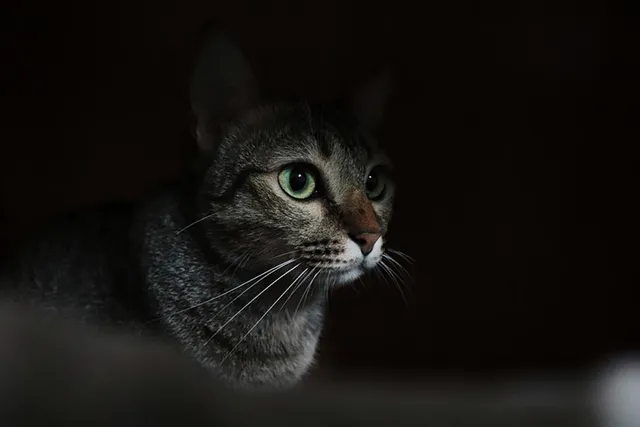
Cats have much better night vision than we do! While they can’t see in complete darkness, they can see incredibly well in low-light conditions. But why is their night vision so much better? A cat’s eye has more rods than a human’s, enabling them to see better in darker conditions. In fact, kitties have so many rods in their eyes that it’s believed that they can see clearly in roughly 1/6 of the light humans need to see properly.

7. Feline eyes are sensitive to movement.
Have you ever wondered how your kitty can keep track of a flying insect? They can do this because the rods in a cat’s eye that help them see better at night are also highly sensitive to motion.
The rods in a feline eye make cats especially sensitive to lateral movement; they also give your kitty a higher “flicker fusion rate.” This is the number of identical images shown per second, perceived as separate still images instead of continuous. Our flicker fusion rate is roughly 50 images per second, but a cat’s is 70 images per second.
8. The tapetum lucidum makes your cat’s eyes shine in the dark.
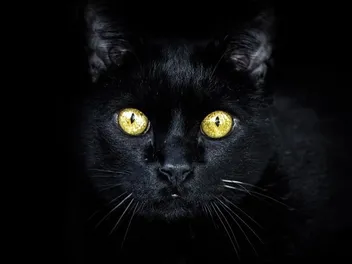
The part of a cat’s eye called the tapetum lucidum is a thin layer situated behind the retina and helps the animal see in the dark. It works as a mirror, reflecting light back to the rods and cones so they get most of the light that enters the eye. This reflection enables a cat to pick up on the smallest amount of available lighting. It’s also what makes a kitty’s eyes shine in the dark!

9. Vertical pupils equal better depth perception.
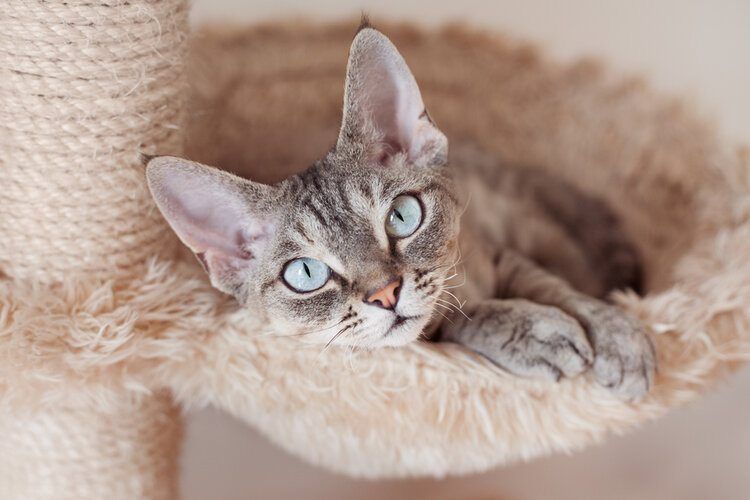
A cat’s pupil is vertical and shaped like a slit, and there’s a reason for this! Pupils change size to let more or less light in. Having a pupil shaped like a slit gives cats more control over just how much light is allowed into the eye. A vertical pupil can also change sizes more quickly than a round pupil like our own and gives your kitty better hunting abilities because it provides them with a sharp image to focus on.
10. Felines probably see colors the way colorblind humans do.
Some have theorized that cats only see in shades of gray, but that isn’t correct. Our feline companions are trichromats, which means their eyes have three types of cone photoreceptors that enable them to see shades of blue, purple, yellow, and green. But just because they have those cones doesn’t mean your kitty sees colors the precise way that you do.
Cat’s retinas have a much lower proportion of cone photoreceptors than rods, which enables them to have excellent night vision. While cats do have color vision, it is not as rich as ours. So, it’s likely that your cat can easily see blues and greens, but colors that fall into the range of red might appear more like blue or green to them. Keep that in mind when you buy items like toys for your pet; blue and green toys may be more eye-catching than red ones!


Conclusion
Your kitty’s eyes may be somewhat similar to yours, but they’re also quite different, so how your pet sees the world isn’t quite the same as how you see it. The feline eye gives your pet much better night vision, motion detection, and peripheral vision, all of which help them be a better hunter. But your cat is somewhat lacking when it comes to seeing colors or objects near the face. Now that you know more about cat eyes, you can ensure your pet’s surroundings are suited to their visual needs!
Sources
Featured Image Credit: Veera, Shutterstock
Expert cat care, straight to your inbox
News, insights, and useful advice, delivered to you.

No spam — unsubscribe anytime.
By signing up, you agree to our Terms & Conditions and Privacy & Cookies Policy.
How useful was this post?
Click a star to rate. You can leave written feedback afterwards. (We read all feedback.)
Misty Layne lives out in the woods in small-town Alabama with her two Siamese cats —Serafina and Jasper. She also has an array of stray cats, raccoons, and opossums who like to call her front porch home. When she’s not writing about animals, you’ll find her writing poetry, stories, and film reviews (cats, by far, her favorite writing topic, though!). In her free time, Misty enjoys chilling with her cats, playing piano, watching indie and foreign films, photographing abandoned places, and catching up on her never-ending TBR list.