Can Cats Eat Figs? Nutrition Facts & FAQ (Vet Answer)

Today, many people eat gourmet meals for enjoyment more than for survival. This leads us to often think of food as a reward or treat, and it’s common to see celebration dinners or use treats for training our pets. There’s nothing wrong with offering out pet treats, as long as the treats are pet-safe. Unfortunately, many foods we eat aren’t safe or healthy for our pets. For the most part, people consider figs to be healthy food.
However, many fruits, including figs, aren’t healthy for your cat. The ideal diet for cats is animal proteins with minimal carbohydrates. Figs are not beneficial to cats, but they are not poisonous. However, the sap in the fig tree can harm your feline.

What are Figs?
Figs aren’t technically a fruit. Instead, they’re inverted flowers, and they’re created through an extraordinary process. Since fig inflorescences are encapsulated, they rely on the fig wasp for pollination. The wasp crawls inside the fig to reproduce, then gets stuck and dies inside the encapsulated structure.
Don’t worry, you do not eat the wasp when consuming the fig! This plant secretes a proteolytic enzyme called ficin that completely breaks down the wasp remains. This allows it to create the tasty fig that we eat; it’s actually made from a wasp!

What’s in a Fig?
Figs are mostly water, fiber, and sugar, though they also contain plenty of healthy nutrients for humans, including potassium, manganese, calcium, magnesium, and more. There’s also ficin, which allows the fig to break down a fig wasp. Besides being found in the inflorescences (which you previously called the fig fruits), ficin is also found in the plant’s sap. Additionally, fig tree sap contains a compound known as psoralen, which is toxic to cats.
Are Figs Safe for Cats?
Figs belong to a large family of trees called Ficus. All species in this family produce sap containing a psoralen called ficusin. Therefore, the sap is a toxic irritant to the cat's skin, eyes, mouth, and gastrointestinal tract. Common signs of ficus toxicity include:
- Drooling
- Diarrhea
- Vomiting
- Irritation of the skin
- Rashes
- Lost appetite
Are Fig Trees & Fig Leaves Toxic to Cats?
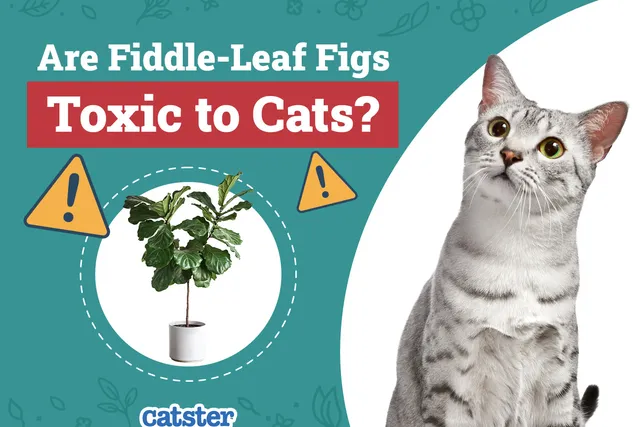
The sap in the fig tree and the leaves is toxic to cats because of a compound (psoralen) called ficusin. Cats can develop mouth or gastrointestinal tract irritation if they chew on the leaves. The sap can also cause skin rashes and eye irritation if cats have direct contact with it.
Why Are Figs Toxic to Cats?
As it turns out, the fig fruit may not be poisonous to your feline. Instead, it’s mainly the plant sap that causes the toxicity. If your cat comes into contact with the fig plant or ingests part of it, irritation will likely result. The fig plant's sap, leaves, and roots contain the highest concentration of psoralens, while the fruit contains appreciably lower levels.
Additionally, the skin and pulp of the fig contain ficin. Fully ripe figs will have lower amounts of ficin and psoralen, though unripe fruits can contain much higher dosages.
What About Fig Newtons?
Fig Newtons are probably most people’s favorite way to consume figs. Of course, they are more like cookies and far less like fruit. Granted, they’re made with fig paste, but the fruits used are ripe and don’t contain much ficin or psoralen.
However, Fig Newtons are still unhealthy for your cat. Cats are obligate carnivores and aren’t great at digesting carbohydrates. Fig Newtons are starchy, sugary balls of carbohydrates that contain wheat flour, baking soda, artificial flavor, and many other ingredients that shouldn’t be part of your pet’s diet.

- NO MESS - The 360° tray on this cat food and water bowl set has a raised design to catch and contain stray crumbs and drips. Protect your indoors and floors from wet and messy meals!
- WHISKER FRIENDLY - Shallow and wide metal containers with flat bottoms ensure your kitty can enjoy mealtime free from whisker fatigue!
- CHEW-SAFE MATERIALS - Kittens and cats love chewing on silicone and soft rubber - but it's a choking hazard. Our cat feeding station materials are anti-chew for a 100% safe feeding frenzy!
Learning about what your cat can and cannot eat is a crucial part of keeping them happy and healthy! Choosing a bowl to serve cat-friendly foods in is another important decision pet owners face. Satisfy the specific needs of your cat with the innovative design of the Hepper NomNom Cat Bowl. Learn why it’s our (and our cats!) favorite food and water dish here.
At Catster, we’ve admired Hepper for many years and decided to take a controlling ownership interest so that we could benefit from the outstanding designs of this cool cat company!
Conclusion
In most cases, it’s not the ripe fruit that’s toxic for felines but the skin of the fruit or the plant on which it grows. That is the case with figs. The ripened fruit isn’t harmful to cats, though it’s still not recommended you feed it to your feline. Instead, the fig plant is toxic to cats, particularly the sap, leaves, and roots. If your cat comes into contact with a fig plant’s sap, they could experience rashes and skin irritation. However, if your cat ingests the plant, diarrhea, vomiting, drooling, and more can occur.
Expert cat care, straight to your inbox
News, insights, and useful advice, delivered to you.

No spam — unsubscribe anytime.
By signing up, you agree to our Terms & Conditions and Privacy & Cookies Policy.
How useful was this post?
Click a star to rate. You can leave written feedback afterwards. (We read all feedback.)
Dr. Paola Cuevas MVZ (Veterinarian)
Dr. Paola Cuevas is the Senior In-House Veterinarian at Pangolia, the parent company of Catster. She has over 18 years of experience as a veterinarian and animal behaviorist. Paola's focus is on preventive medicine and animal welfare. Paola has a large range of skills in from diagnostic imaging to nutrition and clinical pathology. Paola enjoys sharing her extensive knowledge of animal training with our Catster readers and is always happy to answer reader questions as our in-house veterinarian.