Get

In Your Inbox

Catster is reader-supported. When you buy via links on our site, we may earn an affiliate commission at no cost to you. Learn more.

Do Scottish Fold Cats Get Along With Dogs? Facts & FAQ

Scottish Fold and Dogs Get Along

Scottish Fold cats are sweet, mellow kitties with ticked ears and loving personalities. They tend to be social, friendly, and calm. These laid-back pets are relatively healthy, with most living around 11 to 15 years. Female Scottish Folds usually weigh 6 to 9 pounds, with their male counterparts often tipping the scales at upwards of 13 pounds.

Scottish Fold cats form deep bonds with their human companions and do best when surrounded by people and other pets. Because of the breed’s social nature, Scottish Folds get along well with children, cats, and dogs. But to give your pets the best chance of getting along, introduce your four-footed family members to each other slowly and give them lots of time to adjust to each other. Read on for more information about Scottish Fold cats and how to introduce dogs and cats!

divider 2 cats

Do Scottish Fold Cats Do Better With a Buddy?

Scottish Folds tend to be very social. They’re incredibly mellow and enjoy spending time with people and other creatures. They don’t do well when left alone for long periods, leading many owners to adopt these kitties in pairs to prevent loneliness. Scottish Folds tend to develop separation anxiety.

Cats with separation anxiety have terrifying panic attacks when left alone. It’s most often seen in solo, indoor cats that only have one person to meet their needs. Enrichment activities such as interactive toys and food puzzles often help manage feline anxiety.

Scottish fold cat and a caucasian shepherd puppy
Image Credit: Jarodka, Shutterstock

How Do You Introduce Cats and Dogs?

Take things slowly when introducing your pets to each other for the first time. Keep your cat and dog separated until they can be around each other without hostilities breaking out. Set up a dog-free room for your cat so they can escape if they feel unsafe or overwhelmed.

Feed both pets at the same time, but on opposite sides of a closed door, so they start to associate something fun (food) with the presence of the other animal. Periodically switch up their bedding. Let your cat sleep on a blanket your dog has been snuggling in and vice versa to allow the two to get used to each other’s scent.

Most pets can be safely introduced to each other after 2 or 3 days of closed-door acclimation. Leash your dog before introducing the two pets to ensure you can react quickly to any canine shenanigans. Start with short periods and build up over time. Keep an eye on your dog at all times and intervene before any chasing gets underway!

How Long Does It Take for Cats and Dogs to Get Used to Each Other?

No specific amount of time is required for cats and dogs to acclimate to each other. Some pets hit it off as soon as they’re introduced, and others need a bit of time to accept the presence of a new creature in the house. If it goes smoothly and there aren’t any major incidents, the process may only take 2 or 3 days.

Be prepared to keep your pets separated for at least 1 or 2 weeks just in case the introduction process doesn’t go as well as you’d like. Remember that your new pet will also need to adjust to their new home, not just the presence of another companion animal. It often takes dogs around 3 weeks to feel comfortable in a new home. Cats need a bit longer, requiring about 1 month to become comfortable after a move.

Cat and Golden Retriever dog cuddling
Image Credit: Chendongshan, Shutterstock

Which Breeds Get Along Well With Cats?

Golden Retrievers, Labrador Retrievers, Basset Hounds, Beagles, Bulldogs, Pugs, Collies, and King Charles Spaniels are known for being feline-friendly dogs. Other options include Irish Setters and Papillons. German Shepherds, provided they’re well trained, often do quite well with cats.

Look for breeds that tend to be relaxed, laid back, and very trainable. Some dogs, particularly herders such as Blue Heelers and Border Collies, attempt to corral kids and cats. Thorough training is necessary to prevent your dog from engaging in behavior your cat may find threatening. Intervene immediately if your dog begins chasing your cat to keep the behavior from becoming habitual.

Do Scottish Fold Cats Get Along with Other Pets?

Absolutely. Scottish Fold cats don’t have a high prey drive like other pedigree cats, such as Savannah and Bengal kitties. Scottish Folds typically don’t attack guinea pigs, hamsters, mice, and other small critters.

Scottish Folds are a bit more active than your average couch potato cat, but they don’t have a ton of energy to burn, so they’re more likely to curl up next to their favorite human than torment smaller pets.

Aim for two or three brief play sessions per day to keep your pet mentally and physically fit! As an added benefit, a bit of play-based exercise can help your cat maintain a healthy weight which may prevent the development of diseases such as osteoarthritis and heart disease. All Scottish Folds with the breed’s trademark curled ears are at increased risk of developing painful arthritis, making good weight management a must for these cats.
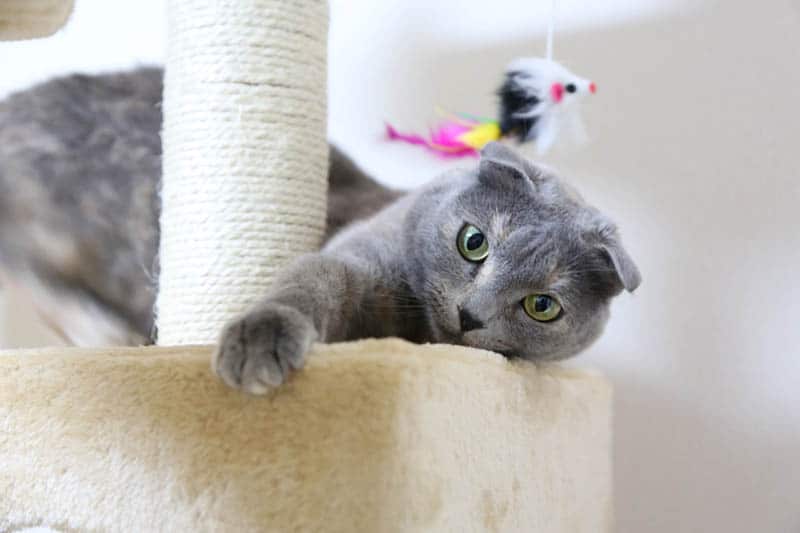
grey scottish fold in a cat tree
Image Credit: 美智子, Pixabay

divider 2 cats

Conclusion

Scottish Fold cats are typically gentle and mellow, meaning they usually get along well with other pets, including dogs. They don’t have high prey drives and prefer cuddling to zipping about. These patient kitties don’t have any specific grooming or dietary needs. Nor do they don’t require a ton of exercise or space, making them ideal pets for apartment dwellers. Scottish Fold cats are a great choice for anyone looking for a friendly companion that gets along well with children, other cats, and dogs!

See Also: 


Featured Image Credit: Sophkins, Pixabay

Want content like this delivered to you?

Sign Up For Our Newsletter

News, insights, expert advice, and everything cat

* By submitting, you agree to our Terms & Conditions and Privacy & Cookies Policy.

How useful was this post?

Click on a star to rate (you can leave written feedback after clicking submit)

Help us improve Catster for pet parents!

Your feedback really matters.

What did you like about this post? Also how can we improve it?

Join the conversation

Leave a Reply

You’re very welcome to leave a comment or question. Please know that all comments must meet our community guidelines, and your email address will NOT be published. Let’s have a positive and constructive conversation.

Talk With A Vet Online

Peace of mind,
anywhere, anytime

Affordable vet advice

How Do Cats Communicate With Each Other? Vet-Verified Facts & Info

Most mammals, including cats, are able to communicate, although non-verbally. Cats have developed forms of inter-cat communication over the millennia; some are vocal,...

8 Best Cat Stairs & Steps in 2026 – Reviews & Top Picks

Whether you have a kitten, an older cat, or a kitty that is post-surgery, cat stairs can be a great addition to your...

My Cat Suddenly Doesn’t Want to Be Touched – 5 Vet-Approved Reasons

If your usually loveable cat suddenly doesn’t want to be touched, you probably have reason to be concerned. It isn’t normal for cats...

How to Treat Lice in Feral Cats: 4 Tips & Tricks (Vet Answer)

Lice on cats are not as common in our pets because of the use of flea and tick-preventative medications. Unfortunately, there is no...

More related

7 Cats That Look Like Leopards (With Info & Pictures)

Domesticated cats have transformed over the years. You can adopt exotic-looking felines or tiny-legged balls of fluff. But when it comes to looking...

Chlamydia in Cats: Our Vet Explains the Causes, Signs & Treatments

Chlamydophila felis (formerly Chlamydia felis) is a bacterium that can infect cats of any age, although young kittens are most often impacted. Clinical...

Can Cats Swim? Truths & Myths About Felines (Vet-Reviewed)

Cats are nimble, agile, and incredibly curious. However, they can also be accident-prone, especially when startled. They can be nervous, shy, and even...

Chocolate Point vs Seal Point Siamese Cat: Key Differences (With Pictures)

A colorpoint cat is one that has light-colored fur with darker-colored ears, face, feet, and tail, which are referred to as the points...

Keep reading

How Long Do British Shorthair Cats Live? Average Lifespan Data & Facts

The British Shorthair cat is well known for its sweet personality, large appearance, and lengthy lifespan of 9–15 years. Providing them with veterinary care and attention, along with a healthy diet and a safe, stimulating environment, can help ensure they...

Blue British Shorthair cat on blue background

Why Is My Cat Only Eating Treats and Not Their Food? 4 Likely Reasons

Oh no! Your cat, who used to be such a good eater, is now ignoring their full bowl but won’t stop meowing for treats. What gives? Well, your cat may just be acting like a kid who only wants to...

calico cat having treats

Can Cats Have Pepto Bismol? Vet-Approved Safety Tips & FAQ Explained

Pepto Bismol is a medication used to treat an array of digestive symptoms in humans—as the jingle goes, “when you’ve got nausea, heartburn, indigestion, upset stomach, diarrhea…” Pepto Bismol seems like a wonder drug for these unpleasant issues, and cat...

Can Cats Have Pepto Bismol

Will a Cat Ear Hematoma Go Away on Its Own? Vet-Reviewed Facts & FAQ

An ear hematoma is a blood-filled swelling in the ear flap, also known as a pinna. Most ear hematomas are a result of an underlying problem, such as an ear infection, ear mites, or skin disease, which causes the cat...

Cat with Aural Hematoma

Identifying & Treating Bug Bites on Cats: 9 Vet Approved Tips

Bugs aren’t just a nuisance for us humans. They will bite or sting anyone they deem a threat, including your innocent and beloved kitty. Your cat might one day be sniffing around your backyard when they gets a little too...

Cat wearing collar scratching and itching

Why Does My Cat Lick Me, Then Bite Me? 5 Reasons for This Behavior

Sometimes our cats do slightly strange things that can leave us scratching our heads. One example is when your cat licks you and then bites you soon after—What’s up with that? Some cats might give you a tiny bite that...

White cat bitting fingers

Nature’s Variety Instinct Cat Food Review of 2026: Recalls, Pros & Cons

Review Summary Nature’s Variety is the brand behind Instinct cat foods, available as wet canned food, dry kibble, and toppers. Its inspiration is knowing that raw diets have the potential to provide your cat with many different health benefits. It’s...

Instinct Cat Food Review

Why Do Cats Roll Around on Their Backs? 7 Vet-Reviewed Reasons (With Infographic)

Cats are peculiar creatures and usually march to the beat of their own drum. Unlike dogs, cats can be particular, especially regarding their bellies. When a dog rolls over on their back and exposes their belly, the dog likely wants...

Fluffy domestic cat stretching on the sofa