Can FIV+ Cats Live With Other Cats? Our Vet Explains the Science

In this article
Feline immunodeficiency virus (FIV) is a cause of an infectious disease of cats. It is similar to HIV (human immunodeficiency virus) in people, which is the cause of AIDS. Feline immunodeficiency virus attacks the immune system and weakens it. FIV is a complex disease, and there is unfortunately no cure.
A big worry for owners of cats that are FIV-positive is whether they can safely live with other FIV-negative cats in a multicat household. Recent research has led vets to believe that the disease is not as easily transmissible as previously thought. However, it is not generally recommended to keep FIV-positive cats alongside FIV-negative ones as the risk of transmission still exists in case of fighting.
This article will discuss the facts surrounding FIV transmission and explore the risks of co-housing FIV-positive cats with FIV-negative ones.

What Is Feline Immunodeficiency Virus?
FIV is a slowly progressive virus that works by damaging cells in the cat's immune system. The ongoing destruction of cells that are integral to the body's defense mechanisms leads to a weakened immune system. When the immune system response is compromised, cats will become vulnerable to secondary infections. One of the challenging parts about the diagnosis of cats with FIV is that they can be positive but have no clinical signs during the asymptomatic or latent stage of illness. Cats can harbor the infection for years and clinical signs may not be apparent for a long time.
FIV weakens the immune system of cats to the extent that they can become very unwell from illnesses that a healthy cat would be able to survive. There is no cure for the virus, only management strategies.
Clinical signs can be very subtle or generalized and non-specific. Typical signs to look for include:
- Weight loss
- Lethargy
- Fever
- Reduced appetite
- Secondary lesions in mouth and on gums
- Poor coat condition
- Swollen lymph nodes
- Discharge from eyes and nose due to secondary respiratory infections
The cat may also be generally run down and take longer than usual to recover from infections. If you see any of the above clinical signs, it is important to make an appointment with your vet so that they can be examined.

How Is Feline Immunodeficiency Virus Transmitted in Cats?
Cats that are infected with FIV typically shed the virus in their saliva. The infection is passed on when an infected cat that is actively shedding the virus bites another cat. This contaminates an open bite wound with the virus. Cats can also become infected by transmission of other bodily fluids, such as blood, and less commonly, FIV can also be transmitted sexually.
Kittens can become infected in utero, less often during birth, or just after birth. It is believed that the virus can pass across the placenta and through the mother's milk to the kittens. Interestingly, transmission of the virus from the queen to the kittens only occurs in only a small percentage of cases.
The good news is that FIV is not capable of surviving for long periods outside of live cells. This means that it is less common for cats to pick it up in their environment. A lot of cats that are FIV positive are known to be fighters in their neighborhood, which is how they contracted the virus. Cats that present with cat bite abscesses should be tested for FIV 8 weeks after they have been bitten to screen for the disease.
How Is Feline Immunodeficiency Virus Diagnosed in Cats?
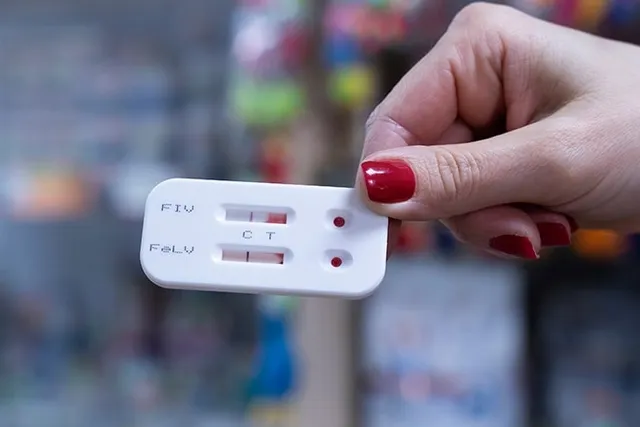
FIV can be complicated to detect. It is diagnosed using a blood test that identifies the presence of specific antibodies to the virus. A test called an ELISA is commonly used. If the test comes back positive, this means that the cat has been exposed to the virus and has produced antibodies. It can also mean that the cat is currently infected by the virus, but the test may produce false positives. These can occur if a cat has received a vaccination against FIV. The test is not able to tell the difference between antibodies produced by an infection with the disease and antibodies induced by a vaccine.
If a cat has been recently infected, they may produce a false negative test as antibodies to the virus can take anywhere from 8 weeks to 6 months to develop. False positive tests may also be seen in young kittens who have received antibodies from their mother across the placenta or via the milk when nursing. Because of this, any kittens that are 4 months old or younger and have tested positive, need to be retested when they are over 6 months old.
Due to these issues with testing, it is recommended that any cats testing positive should be retested at a later date. The blood test should be sent off for a PCR test or a Western blot test as these are more definitive and can give more comprehensive results.

What Does the Research Say?
Recent studies have suggested that there is a low risk of transmission through casual contact in multicat households. There have also been suggestions that the presence of Feline Leukemia Virus (FeLV) could increase the risk of FIV transmission.1 This is why it is so important to test cats for viruses such as FeLV before introducing them to FIV-positive cats.
Cats that are kept indoors and therefore do not encounter other cats not in their household have a lower risk of potential transmission.
Vaccines and FIV
There are some vaccines available for FIV, but it is not clear how reliable they are. A vaccine has not been available in the United States since 2016, and is currently available mainly in Australia, New Zealand, and Japan. Vaccines are also problematic when it comes to interpreting the results, in that a cat that has been vaccinated will test positive for FIV. There is no way to determine if the antibodies have been made in response to an infection or if they have been induced by a vaccine.
There is no known benefit to giving the vaccine to a cat that is already infected with FIV. Therefore, it is necessary to test cats and kittens whose clinical history is unknown before they receive a vaccination.

Can FIV-Positive Cats Live with FIV-Negative Cats?
If a cat is FIV-positive, ideally, they should not be housed with FIV-negative cats. There are some conditions where FIV-positive cats can live with FIV-negative cats, but owners need to be aware that this is not generally recommended, as the risk of disease transmission is still present, however small.
Factors that influence the likelihood of transmission include:

How to Care for a Cat with FIV
Cats with FIV can still live a long and healthy life despite having the disease. There are a few changes that need to be made, which include:
- Housing them on their own if possible: As mentioned above, cats with FIV should be housed in a single-cat household. To prevent the spread of FIV, it is vital that FIV-positive cats are kept on their own, no matter how small the risk may be.
- Keeping them indoors: If you have a cat that has tested positive for FIV, it is important to keep them indoors. This prevents them from picking up other illnesses, as well as protects other cats they come in contact with, in case of a cat fight. Owners can allow their cats access to the outside world by using a “catio” setup or letting them out in their own backyard supervised on a leash.
- Ensuring they are in good health: It is very important that FIV-positive cats are kept as healthy as possible. They should be taken to the vet as soon as they show any clinical signs of being ill. They should be vaccinated and up to date with flea and worm treatment.

Conclusion
It is generally not recommended to house FIV-positive cats alongside cats that do not have the infection, unless it’s a well-established social group where there is no fighting. There are many ways to reduce and minimize the spread of the disease, and the risk of transmission is lower than previously believed. Despite all this, it does not matter how many precautions are taken, there is still a chance the disease will be passed on to other cats. FIV can be a debilitating disease and vets and owners must commit to minimizing the spread of the virus to reduce the number of cats affected.
Sources
Featured Image Credit: megaflopp Shutterstock
Expert cat care, straight to your inbox
News, insights, and useful advice, delivered to you.

No spam — unsubscribe anytime.
By signing up, you agree to our Terms & Conditions and Privacy & Cookies Policy.
How useful was this post?
Click a star to rate. You can leave written feedback afterwards. (We read all feedback.)
Dr. Emma Chandley, BVM MRCVS (Veterinarian)
Dr. Emma is an experienced vet who is happy to share her expertise and knowledge about cats with readers. Her passion is surgery but she will happily talk about anything animal-related. Dr. Chandley graduated from The Royal Vet College and since then she has worked in general practice in Great Britain. Dr Chandley has completed a postgraduate certificate in Small Animal Surgery and has also gained Advanced Practitioner status in the same discipline. She enjoys developing her skills in animal behavior, nutrition, and clinical pathology as well.