Ask Dr. Paola – HELP! Should I Use An Allergen-Neutralizing Spray? (November 2, 2026)


Welcome to our "Ask Dr. Paola" series, where every other Monday we bring expert advice straight from Dr. Paola Cuevas (MVZ) to help our readers better understand their cat's health and well-being. Whether you're a new pet parent or a seasoned cat lover, Dr. Paola is here to provide answers to your most pressing questions. From nutrition tips and preventive care to troubleshooting common behavioral issues, Dr. Paola is ready to offer insights that will keep your kitty happy, healthy, and feline fine. Stay tuned for expert guidance on a range of topics that matter most to you and your cat, so you can make informed decisions and provide the best possible care for your furry companion.
Have a question? Send it in here!

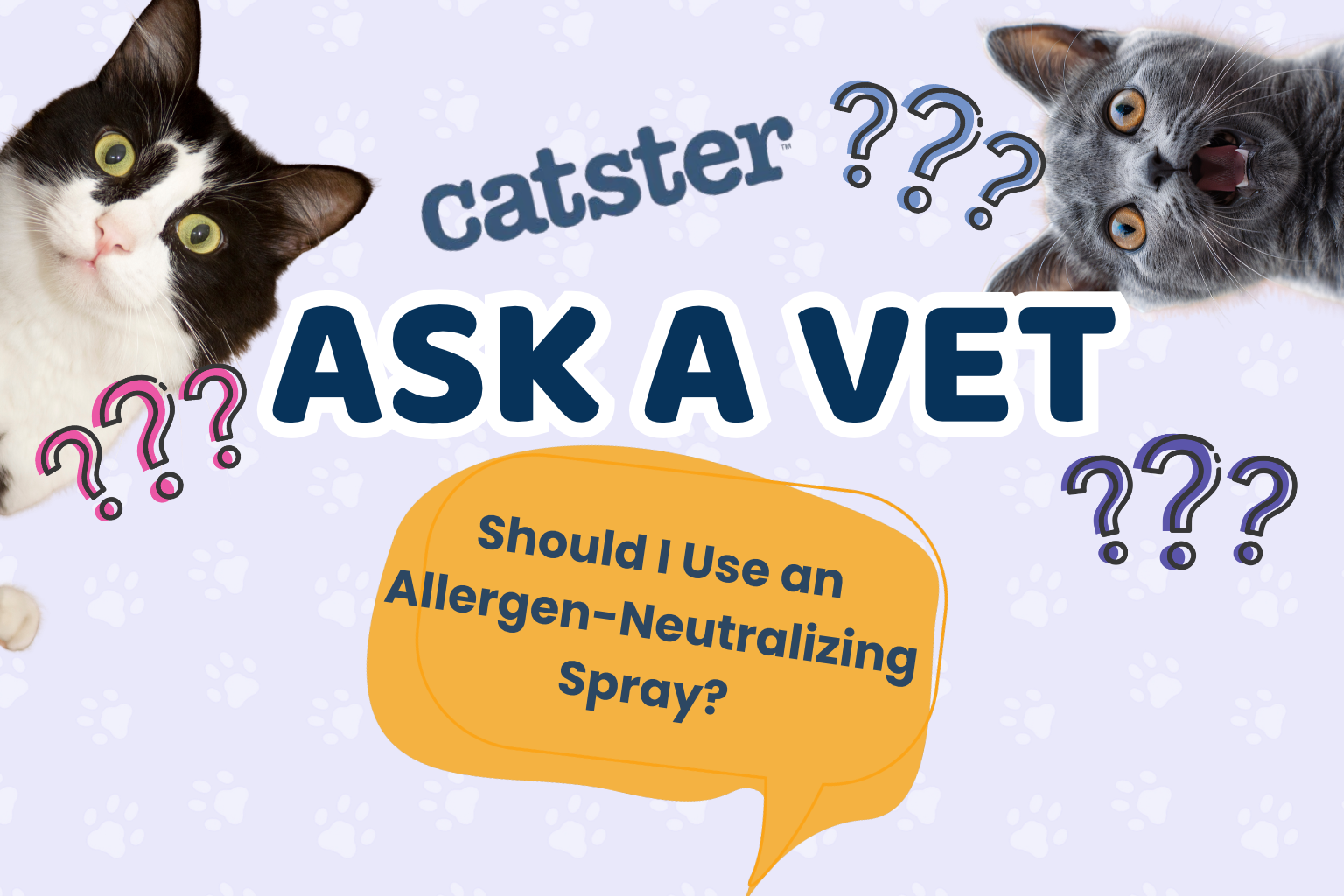
HELP! Should I Use An Allergen-Neutralizing Spray?
“Hi Dr Paola,
My 1-year-old cat Daisy has allergies. She is on a special hydrolyzed diet. I’m trying to find an allergen-neutralizing spray to cut back on dust mites in the house. Would you recommend any specific products?
Thank you”
- Patricia
Dear Patricia,
Since Daisy is already on a hydrolyzed diet, it makes sense to look at environmental allergens too, especially if her allergic signs are continuing. Dust mites are common household allergens, and while the goal is to reduce the amount of allergens in her environment, eliminating them completely is not realistic. Regularly washing bedding and blankets, vacuuming with a HEPA filter, and keeping dust to a minimum are still the best places to start.
If you would like to try a spray, Purefy Anti-Allergen Spray works differently from an insecticide. It is intended to neutralize or remove the allergenic proteins associated with dust mite debris, particularly the proteins found in their feces and other microscopic particles that accumulate in household dust and fabrics. Those proteins, rather than the living mite itself, are an important source of the allergic reaction. So the idea is not to kill every mite in the house, but to reduce the allergen they leave behind.
I would specifically avoid routinely using insecticide or acaricide sprays around Daisy, even when a product is marketed as “natural.” Cats can be particularly sensitive to certain botanical ingredients and insecticides, including some essential oils and pyrethroids. If you use an anti-allergen spray, follow the label carefully, keep Daisy away from treated surfaces until they are completely dry, ventilate the area well, and never spray it directly on her or on surfaces she is likely to lick. Please ensure you also keep it away from food and water bowls.
Think of the spray as an extra layer of environmental control, not a treatment for Daisy's allergy. The unglamorous combination of washing, HEPA vacuuming, and reducing dust is still doing most of the heavy lifting. And if Daisy continues to have significant allergic signs despite a properly conducted hydrolyzed diet trial and environmental management, it is worth investigating other possible triggers rather than simply reaching for stronger household chemicals. Usually, the answer is not a more powerful spray, but figuring out exactly what is making your cat itchy. So, real detective work is often needed for success.
I hope this helps!
- Dr. Paola
This article is a part of our weekly Ask Dr. Paola series

Expert cat care, straight to your inbox
Vet-reviewed advice, behavior tips, and the best of Catster. Free, and you can unsubscribe anytime.
By signing up, you agree to our Terms & Conditions and Privacy & Cookies Policy.
As a certified cat-lover, Radim was excited to join the Catster team on the mission to help all the cat parents in the world by providing useful and helpful information. He used to live with two wonderful cats before embarking on his travels around the world. Radim currently lives in Slovakia, surrounded by nature and his neighbors' cat community.
Join the conversation
Ask a question, share your story, or send private feedback.