How to Stop Your Cat Biting When Playing: 7 Vet-Reviewed Tips


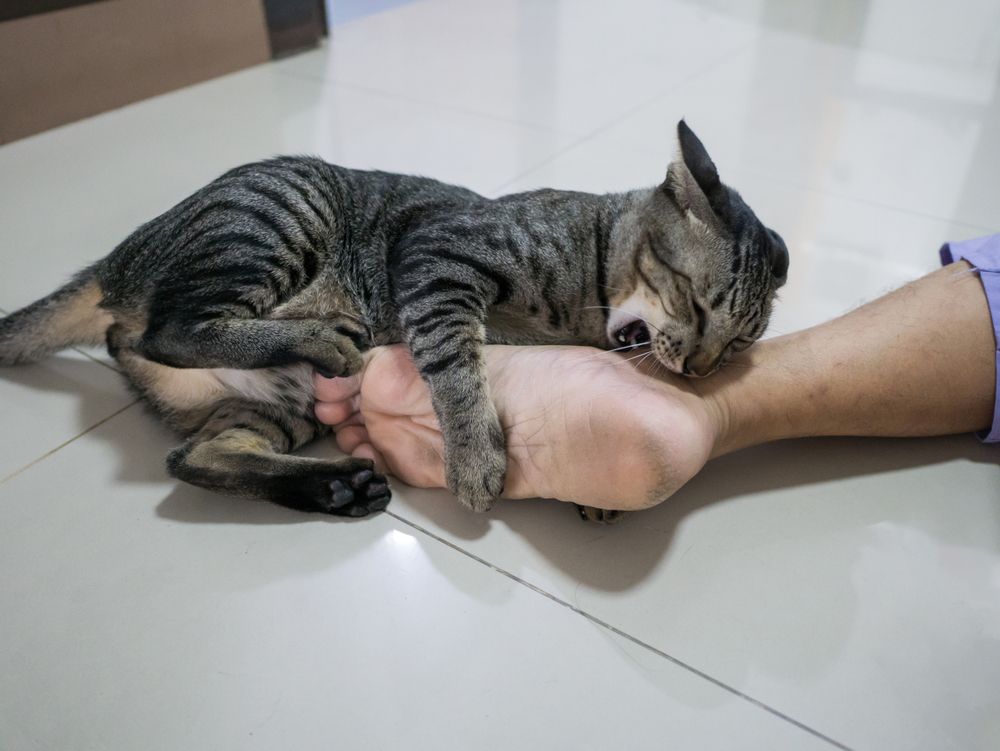
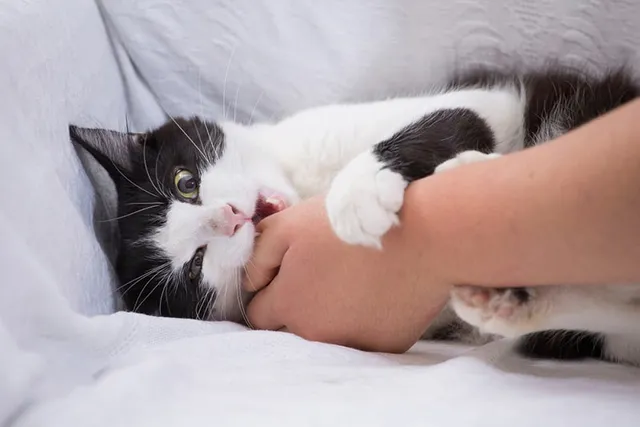
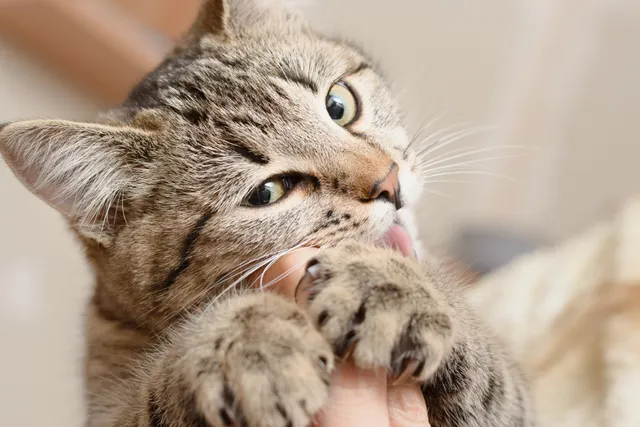
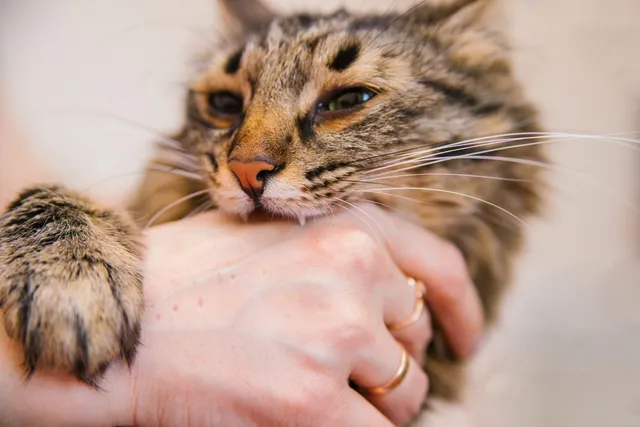
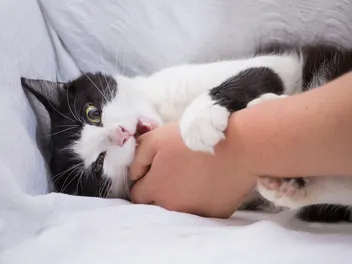
If you are playing with your cat and they seem to bite you out of nowhere, you might feel put out, hurt, or even angry! While this behavior is not ideal, there are usually good reasons why your cat has lashed out.
Cats are natural predators, and stalking, pouncing, and biting are instinctual. However, cat bites can also be dangerous, so it is equally important to stop them from biting you when playing! In this article, we’ll look at 10 tips to help you stop your cat from biting you when playing.

Top 7 Vet-Reviewed Tips to Stop Your Cat Biting When Playing
1. Don’t React
The first thing to do (and probably the most difficult!) when your cat bites you is to ignore them. Even a negative reaction can reinforce the behavior, and your cat will think it’s part of the play. Reacting in a way, such as sharply pulling your hand away, can also seem like a game.
You have to stop the behavior, but staying calm when it occurs can reduce the behavior and even stop it (when combined with the other tips below). Your cat is pre-programmed to bite down harder when their prey tries to flee as a natural hunter, so removing this trigger by keeping your hand still can help them resist the urge to chase.

2. Redirect the Behavior
Redirecting your cat’s play biting to a more appropriate object can prevent them from attacking you. Many cats can easily be distracted and will latch on willingly to a toy, particularly toys with tactile and multisensory input like kickers.
As soon as your cat shows signs of an attack, grab the toy and tease them with it. Lead them away from your hand and body and let them have the toy. Kicker toys are great for this, and your cat will have something satisfying to bite into while kicking furiously with their hind legs. It’s entertaining to watch!
Looking for toys that will cater to the many needs of your cat? The Hepper Hi-lo Cat Scratcher is one of our favorite cat products, and it will encourage your cat to get active. Its clever three-angle design offers multiple ways for your cat to climb, stretch, and exercise. Made of a sturdy plywood base and a replacement cardboard insert, this scratcher is an option that cats can enjoy for years to come. If your cat requires a little encouragement for self-play, the Hepper Catnip Mice Toy Set is a fantastic choice for their instinctual needs. Made with natural, bite-resistant hessian fabric and filled with organic catnip. Cats can satisfy their natural prey instincts while getting the physical activity they need to thrive.
| Image | Product | Details | |
|---|---|---|---|

|
Hepper Hi-Lo Cat Scratcher |
|
Check Price |

|
Hepper Catnip Mice Toy Set |
|
Check Price |
At Catster, we've admired Hepper for many years, and decided to take a controlling ownership interest so that we could benefit from the outstanding designs of this cool cat company!
3. Respect Their Boundaries
If your cat seems to bite you out of nowhere when you try to pet them when playing or touch a particular area of their body, you might have overstepped their boundaries. Cats have certain areas on their body that they don’t like being touched.
Most cats enjoy being petted or touched on the tops of their heads, cheeks, and backs, but many dislike being touched anywhere on their abdomen or feet. These areas may be hypersensitive to touch and are the first to be targeted by other cats. Since playing is a simulation of the hunt for cats, they are often very sensitive about their bellies being touched.

4. Be Mindful of Other Types of Biting
While play biting is an issue that should be resolved, other causes of biting can be very serious and require urgent attention. Getting bitten by a cat that doesn't usually bite could be a sign that they’re in pain or stressed.
Cats bite for various reasons, such as:
- Pain
- Stress
- Fear
- Illness
- Overstimulation
Determining the cause of your cat’s biting can be difficult, particularly as many of the causes show similar behavioral signs. As a quick reference guide, the following signs are all behaviors you should look for if your cat suddenly begins biting during play:
- Pain: Hunched body position, reacting to a specific area being touched, crying out, poor grooming, limping, hiding, not eating properly
- Stress: Hiding away, poor grooming, poor eating habits, obsessive behaviors
- Fear: Warning signs (dilated pupils, raised fur), hissing, growling
- Overstimulation: Tail flicking, flattened ears, skin rippling
If you think your cat could be biting when playing for any of these reasons, you should consult a veterinarian.
5. Observe Their Body Language
Cats are very adept at conveying how they feel during any given moment with body language. However, this tends to be very subtle! The subtlety makes it difficult for us to interpret, and it can make certain behaviors (like biting during play) seem to come out of nowhere.
Learning your cat’s body language and observing cues that they’ve had enough of play or don’t like something is a great way to avoid bites that stem from overstimulation or annoyance.
Some of the behaviors we covered above (tail flicking and ears rotating out to the side, for example) can be the more obvious signs your cat gives you when they’ve finished playing. Other more subtle body language that can indicate your cat has had enough includes:
- Tensing
- Extending their claws
- Turning their head quickly to your hand
- Twitching their tail
- Dilated pupils

6. Don’t Punish Them
The worst thing you can do if your cat bites is to punish them. Most cats who bite during play are doing so as part of the game, or they are simply reacting to being overstimulated. By yelling or raising your voice at your cat, you’re teaching them that what they’re doing is right because you’re responding to their actions or that they should be afraid of you.
It’s much better to slowly pull your hand away to let your cat know that biting means no more playtime. You must never hit or hurt your cat; physically hurting your cat will make them fearful of you and more likely to bite out of fear.
7. Give Them a “Time Out”
One of the most effective ways to prevent your cat from biting you during play is to give them a “time out” when they do. A time-out is easy to do, and your cat will learn quickly that biting is a surefire way for the play to end.
When your cat bites you, stand up immediately and turn around so you’re facing away from them. Don’t say anything or shout out; completely ignore your cat! This should only last for a few minutes. When this is done, resume playing.

8. Don’t Instill Inappropriate Behaviors
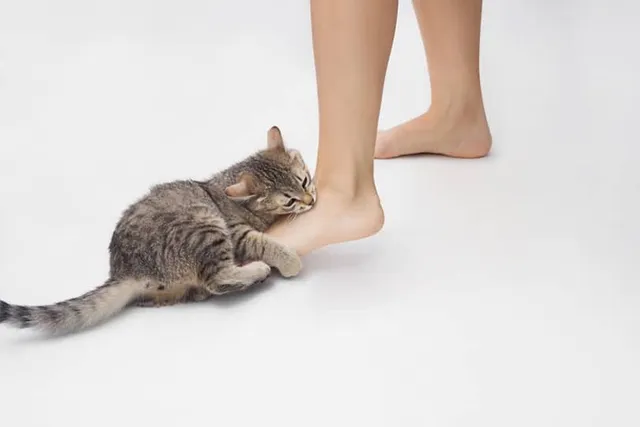
It’s easy to relent and play with your cat, but it’s important to remember that hands and feet are not toys! As tempting as it may be to indulge them, make sure not to play with your cat with your hands or feet under the bedcovers, too.
These behaviors are learned quickly, and your cat will learn that biting you is okay and fun! You can prevent play-biting by not encouraging your cat from a young age.
9. Give Them Plenty of Stimulation
Cats often act out when bored, and it’s vital to provide toys to keep them entertained as well as physical exercise and environmental enrichment. If your cat doesn’t have access to appropriate toys, such as kickers or catnip-filled toys, they’ll play with the next most exciting thing: your hands and feet!
Finding the perfect toy for your cat and playing with them daily will help redirect biting onto it and save your hands.

10. Consult a Veterinarian
If you’ve tried to prevent your cat from biting you and nothing seems to be working, or you’re concerned that they might be unwell or in pain, you should take them to the vet. Getting help from a vet to rule out any physical causes of the play biting is an important step.
Once they’ve given your cat a clean bill of health, a vet can recommend a qualified behavioral consultant who can work with you to reduce and stop your cat’s play biting for good.
What Should I Do If My Cat Bites Me?
If your cat bites you during play, it’s very important to wash the area thoroughly with soap and water, but avoid harsh cleaners. If they break the skin, you should seek medical attention immediately after washing the wound.
While tiny, any cat bite (or scratch) can become infected by bacteria your cat carries in their mouth. When a cat’s tooth punctures the skin, pathogenic bacteria such as Pasteurella multocida are injected deep into the skin’s tissues.
The outer wound on the surface of your skin will then close up quickly, sealing the bacteria inside. This can cause an infection in 24-48 hours, and treating it is incredibly important.
Conclusion
Play-biting in kittens may seem harmless, but that isn’t the case. Even kittens can pass on dangerous bacteria through bites, and adult cats who don’t understand that biting hurts (even during play) can cause severe damage.
It can be easy to react out of pain when your cat bites you, but remember, they’re only displaying natural behavior. By staying calm and redirecting your cat’s biting to a toy or putting them on a “time out” from playtime, you can quickly teach them that biting hands is not okay and that there are other (more satisfying!) targets to pounce on.
Sources
https://www.aspca.org/pet-care/cat-care/common-cat-behavior-issues/aggression-cats
https://www.wihumane.org/behavior/ask-the-experts/cat-behavior/overstimulation-to-petting
https://vcahospitals.com/know-your-pet/wounds-cat-bite-injuries-to-humans
https://vcahospitals.com/know-your-pet/cat-behavior-problems---aggression---petting-aggression
https://vcahospitals.com/know-your-pet/play-and-predatory-aggression-in-cats
Featured Image Credit: Chomphuphucar, Shutterstock
Expert cat care, straight to your inbox
News, insights, and useful advice, delivered to you.

No spam — unsubscribe anytime.
By signing up, you agree to our Terms & Conditions and Privacy & Cookies Policy.
How useful was this post?
Click a star to rate. You can leave written feedback afterwards. (We read all feedback.)
Beth is a mom to two toddlers: one with four legs, one with two. Beth has years of practical experience as a veterinary care assistant, working in both the operating room and in consult, expanding her knowledge to gain certification in her favorite subject: feline behavior and welfare! When she's not writing about her favorite topics (cats and creature comforts), she's looking after her two-year-old daughter and her mischievous eight-year-old Nebelung, Kiba. When she gets a moment's respite, Beth loves to delve into fiction books. Horror is her favorite genre, with fantasy and rich history being her second go-to's.