Why Does My Cat Act Like My Child? 10 Vet-Verified Reasons


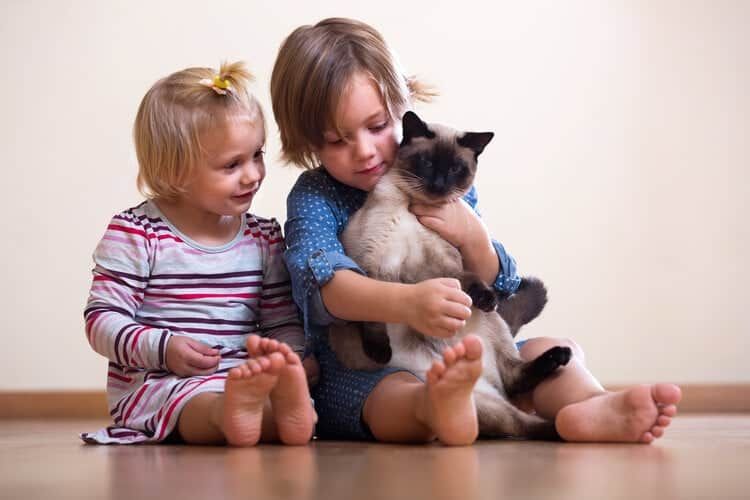
Our relationship with our feline companions has evolved dramatically through the ages. They’ve gone from wild animals to beloved pets. About 95% of people think of their companions as family members.1 Some may do the job that endeared them to us. However, they’re more likely to cuddle beside us on the sofa than look for dinner.
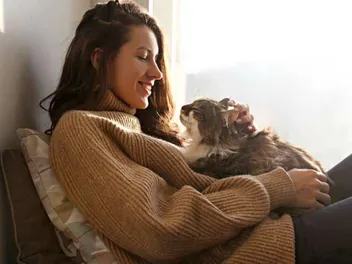
Many people refer to themselves as pet parents and their animal companions as their fur babies. It’s no wonder that some cats take this role literally and act like kids. Here are 10 reasons why your cat might act like your child.

Top 10 Reasons Your Cat Acts Like Your Child:
1. Domestication
Domestication hasn’t changed our pets too much physically. Research has shown that only 13 genes have changed through natural selection during our 12,000-year relationship.2 Unsurprisingly, many of those adaptations involved areas of the brain responsible for behavior. The mere act of bringing cats into our homes has affected them profoundly and set the stage for acting like our children.
2. Cuteness Factor

You don’t have to watch cat videos on YouTube to make people love their pets. Research suggests the cuteness factor is at work. Humans have adapted to respond to baby faces that may have transcended to our cats. It makes sense for a parent to react to their baby’s needs and emotions since it ensures their genes are passed on to the next generation. Scientists theorize that animals elicit similar reactions.
3. Feline Emotional Maturity
If you have a young child, you may notice comparable behaviors in your kitty because they are on par emotionally. One study found that felines possess the six primary emotions, making their emotional maturity roughly that of a 2.5-year-old child.
The emotions cats possess include the following:
Terrible twos may also apply to our feline companions—sometimes.
4. Learned Behavior

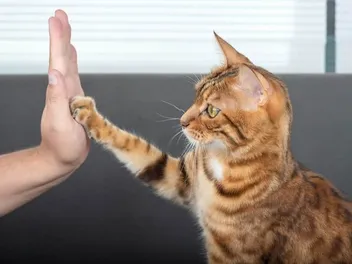
If your cat displays unwanted behavior, such as begging or waking you up before the alarm, it may occur because your reactions have conditioned your pet. When the animal gets what they want, you inadvertently reinforce it with a positive experience and reward. It may take a few times to break the vicious cycle, but it’s possible with patience and consistency.
5. Treatment as a Family Member
We mentioned people’s attitudes toward their pets. Cats respond to this treatment. They observe and learn from being treated as family members. Remember that felines are intelligent. However, they’re less patient than dogs. They’ll stay interested if they’re rewarded. After all, cats are highly food-motivated. The bonding experience with your pet can encourage child-like behavior.
6. Behavioral Associations

Your pet is a keen observer of the patterns and routines of your household. That can lead them to make associations of cause and effect. They figure out what works. How the animal was socialized plays a significant role. Kittens separated from their mothers and littermates are more likely to be fearful. That can impact how they interact with you.
7. Kneading Behavior
Cats have many endearing behaviors that strengthen our bonds with our pets. Your child undoubtedly enjoys cuddling with you. Your kitty may display the feline version of it when they knead you. Scientists have speculated that it may mimic a kitten during nursing. After all, you give your pet food. It may also comfort the animal, not unlike the feelings a little one has when clinging to their mother.
8. Baby Talk

People instinctively baby-talk to their children. Many pet owners will also use this communication with their animal companions. Domesticated cats have responded by meowing for our benefit. It’s not a human-directed behavior in wild felines. We encourage it, especially when a treat or similar reward follows it. Again, it’s another example of learned behavior.
9. Our Babies
Most pet owners are probably guilty of anthropomorphic thinking. We treat our animal companions like small children, leading us to interpret their behaviors in that context. We make the associations because we want to see them. Many may find it endearing to watch their cats respond to what they interpret as appropriate. If your kitty reminds you of your child, there’s a good reason.
10. Mutual Love

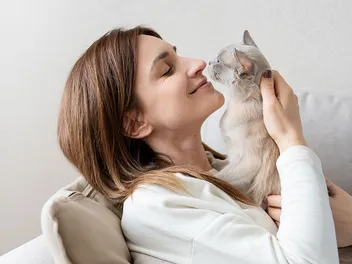
People think of dogs as being the ultimate companion and man’s best friend. While it’s true we’ve had a longer relationship with canines, that doesn’t mean we can’t form similar bonds with cats. However, research shows that felines and humans become emotionally attached. Moreover, these relationships are comparable to those between humans and children.

Conclusion
It’s not your imagination when you notice your cat acting like your child. They are capable of good and bad behaviors. Felines learn from observing and exploring their world. They fall into the household’s routine and figure out how to get their way in sometimes inappropriate ways. However, evolution made it inevitable that our pets would behave and love us like our kids.
We respond to their cute faces and actions as if they were human children. We talk to them like babies, teaching them to make associations that benefit them. In return, we get their love and attention with priceless bonds.
Featured Image Credit: Bear Fotos, Shutterstock
Expert cat care, straight to your inbox
News, insights, and useful advice, delivered to you.

No spam — unsubscribe anytime.
By signing up, you agree to our Terms & Conditions and Privacy & Cookies Policy.
How useful was this post?
Click a star to rate. You can leave written feedback afterwards. (We read all feedback.)
Chris has been a science-focused pet writer since 2009, specializing in health and the environment. She lives with her husband Norm and three amazing cats in the land of 10,000 lakes. When she's not writing about cats, Chris also enjoys boating and sampling wine. She has her WSET 1 and 2 certifications and is currently pursuing her Certified Wine Specialist Award (CSW).