How Do Cats Perceive Time? Vet-Reviewed Science & Info


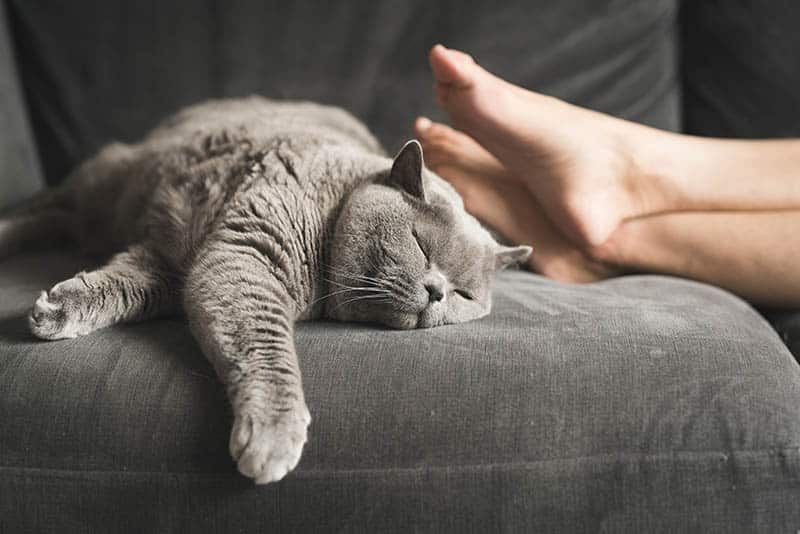
If you own a cat, you know that they have an amazing sense of time, especially when they wake you up every morning at the same hour (and practically the same minute) to demand that you make their breakfast. Without access to alarms and timers (or being able to read), how is it that cats seem to know precisely what time it is every day? One of the things that cats can do is learn to recognize the routines of their owners. They also rely on their circadian rhythm and sense of smell to perceive time. If you’re curious to find out more, read on. We have all the surprising details about how cats perceive time!

Do Cats Perceive Time?
Researchers have found that cats perceive the passing of time, but they do so somewhat differently than humans. The average cat doesn’t perceive time as you do but instead, relies on several of their senses, including visual cues, the routine of their owners, internal sensors, and even the environment, such as sunlight and darkness. Cats also have a circadian rhythm like humans and use that to tell, more or less, what time of day it is. How they track the passing of time, however, is similar to how our brains perceive the passage of time (through a part of the brain known as the prefrontal cortex).
Can Cats Sense That Time Is Passing?
Yes, cats can sense the passage of time. In experiments involving cats, they could easily be trained to distinguish a 5-second interval with great accuracy1. They could even distinguish the interval from a time span of 8 seconds or 10 seconds.
Anyone who’s had a cat can probably attest to the fact that their pet knows precisely when they should be fed. Felines will often wake their owners at the same time every day, accurate to the minute. This further reinforces the concept that cats can sense time passing and can learn when to expect certain things on a daily basis.


Do Cats Miss You When You’re Gone?
A common misconception about cats is that they can take care of themselves if given food, water, and something to play with. Many people inaccurately believe that this is a sign that cats don't care when their owners go away, but research shows that cats do miss their owners. Cats that were separated from their owners for increased periods of time spent more time interacting with them when they returned2. This means social interactions likely play a vital role in a pet feline’s life, so it’s highly likely that a cat that likes you would miss you in your absence.
Does Time Move Faster, Slower, or the Same as Humans for Cats?
To date, researchers have not been able to answer this question definitively. It is well known that cats do have a faster reaction time than humans do, on average. However, this doesn’t correspond to the way that they would perceive the passage of time.

Can Cats Tell How Long You’ve Been Gone?
Like dogs, cats are able to smell the passage of time. Your cat may be able to tell how long you’ve been away by noticing how weak your scent progressively gets while you’re gone. Although they wouldn’t be able to quantify this in terms of hours or minutes, it would give them an indication of when they last smelled you.
Another way cats keep track, more or less, of time’s passage is that they have an internal clock, or circadian rhythm. Like a human, a cat’s circadian rhythm is always ticking inside their little, furry body, prompting them to, for example, get up (usually around dusk) and go to sleep (often around dawn). It is worth keeping in mind that an indoor pet cat may easily adjust their timing to wake up and wind down at different hours, much like how we can adjust to night shifts if necessary.
The circadian rhythm does not tell time, per se, but it does help your cat sense the passage of time so they can live optimally (and know when their next meal will be served).

Do Cats Think of Times That Have Passed?
It has not been established whether cats can actually reminisce about the past. However, felines do have memories, as this is important for their survival. A cat in the wild would need to remember where the best hiding spots, vantage points, dens, and prey ambush areas are in their territory. They would also benefit from remembering past events (traumatic or positive) to either seek those experiences again or avoid them.
Therefore, cats can definitely draw on memory, but whether they do so philosophically is not yet known. That said, they’ve also been shown to have a clear understanding of time itself.

Can Cats Sense When the Time Zone Changes?
What happens if a cat changes time zones? Much like us, their circadian rhythm can become disrupted when this happens, and they can also experience the effects of jet lag. However, just like us, they can eventually adapt to different time zones over a period of several days to a few weeks.

Final Thoughts
From what research has shown, cats do perceive time, as like all living things, they have a circadian rhythm, and part of perceiving their environment is also interpreting time. Although they don’t use time for the same purposes that we do (they don’t have work deadlines!), they do rely on general awareness.
In short, cats perceive time as part of their day-to-day lives and can definitely keep track of time in their own way.
See Also:
Sources
Featured Image Credit: Carlos G. Lopez, Shutterstock
Expert cat care, straight to your inbox
News, insights, and useful advice, delivered to you.

No spam — unsubscribe anytime.
By signing up, you agree to our Terms & Conditions and Privacy & Cookies Policy.
How useful was this post?
Click a star to rate. You can leave written feedback afterwards. (We read all feedback.)
Gregory Iacono former chiropractor and self-taught writer. Greg has experience in a wide variety of subjects including video script. As a man of clinical experience, Greg has the ability to digest a complex subject and make it accessible to the reader. Greg enjoys traveling and spending time with his two daughters and son.