Bobcat vs House Cat: The Differences Explained (With Pictures)


In this article
Cats are cats, whether big or small, wild or domesticated, right? Not exactly. Wild feline species, such as the bobcat have some significant differences from their house cat counterparts. That doesn’t mean they don’t also have similarities, but the differences are far greater. Though perhaps the most crucial difference to remember is that wild cats are just that—wild.
Below you’ll find the biggest differences and some similarities bobcats and house cats have, so read on to brush up on your cat knowledge.

Visual Differences

At a Glance
Bobcat Overview

The bobcat has been around for a long time—a really, really long time. Believed to be a descendant of the Eurasian lynx, the modern bobcat came into existence approximately 2–3 million years ago, with the species Lynx rufus diverging from Eurasian lynx ancestors during the Pleistocene epoch. And these days, they are one of the most abundant wild feline species in North America. Though they greatly resemble the modern house cat, there are some major differences between the two species (not least of which is the bobcat’s solitary, territorial personality).
Characteristics & Appearance
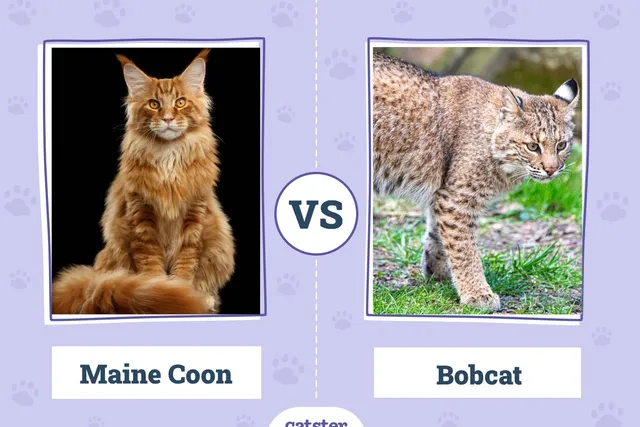
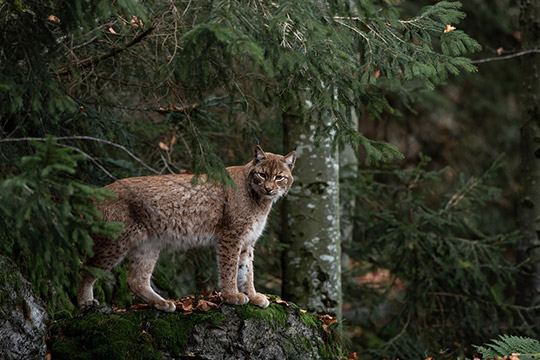
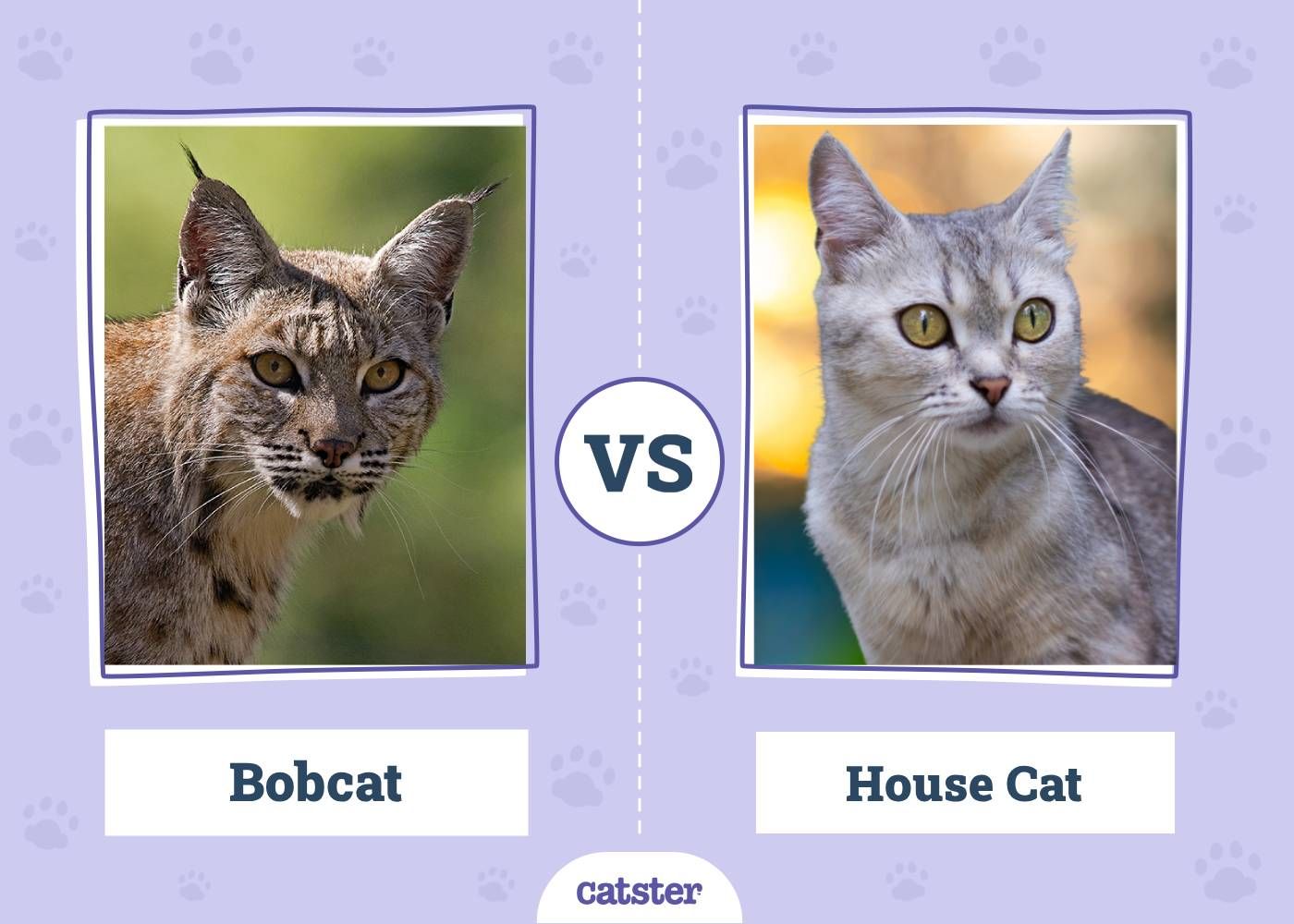
You can absolutely tell a bobcat from a house cat by its appearance, even with the similarities. Not only is the bobcat larger than house cats by a few good inches, but there are other easily identifiable differences.
For one, bobcats will usually have a coat that is red-brown to grayish-brown, often with dark spotting or barring. They’ll have white bellies with black spots, as well as black streaks or spots around the ears and on their limbs. A bobcat’s eyes are yellow-green to golden and the breed is known for the tufts of hair on the ends of their ears and along the legs. They may also have tufts on their cheeks that resemble mutton chops.
Another easy-to-see difference is the bobcat’s tail; the name bobcat comes from its tail, which is bobbed and short (between 4–7 inches long).

Noises
Though bobcats and house cats make similar noises when they are kittens—purring, growling, hissing—these sounds change as the bobcat ages. Older bobcats make a noise akin to a crying baby or screaming woman (which can, frankly, be quite alarming to hear!). And when it’s time to mate, bobcats make loud, growling noises that echo.
Tracks
Because they are both felines, the bobcat and house cat both walk with a direct register gait, which means when the front foot is lifted, the hindfoot on the same side walks in the same spot as the front did. This lessens the amount of noise and tracks made by walking and provides footing that is more stable.
However, a bobcat’s tracks will be larger in size than a house cat’s tracks. Typically, tracks will be between 2–2.5 inches wide; they will also be further apart since a bobcat’s gait is longer than a house cat’s gait.
Housecat Overview

We’re all familiar with the house cat (and many of us are proud cat parents). Cute, cuddly, and persnickety, these felines enjoy playing and lazing about. And as different as they are from the bobcat species, they do have some commonalities. For example, house cats are believed to have been domesticated approximately 9,000–10,000 years ago, originating in the Middle East. Their wild ancestors, however, date back much farther. House cats also resemble the bobcat in looks just a bit. Just keep in mind that though our house cat friends are domesticated and happy to hang out with us, bobcats absolutely are not!
Characteristics & Appearance
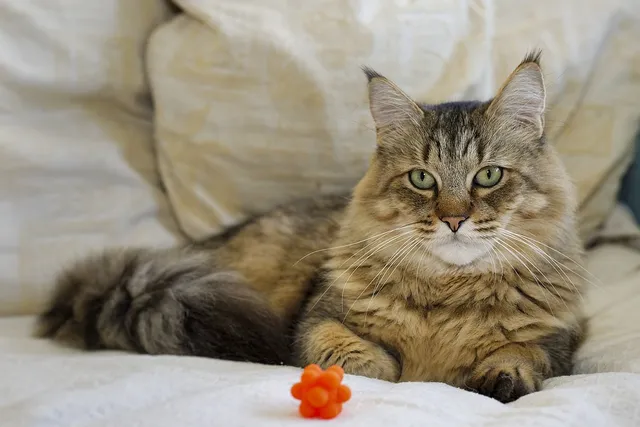
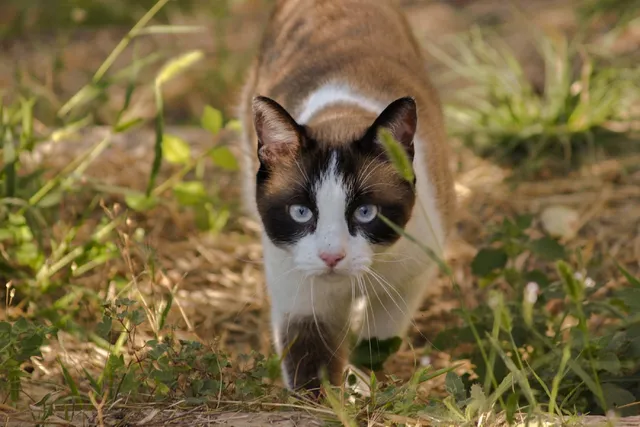
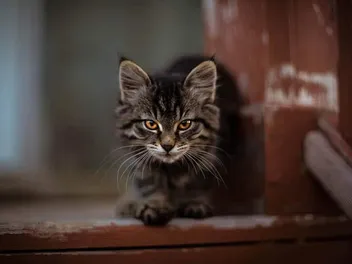
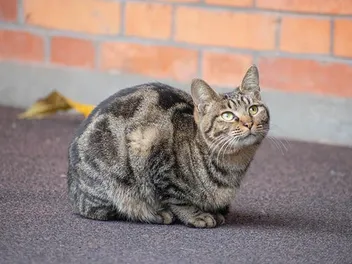
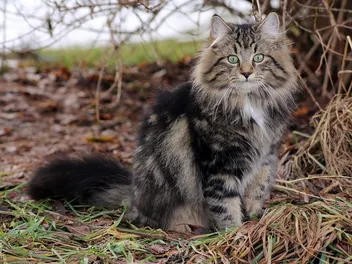
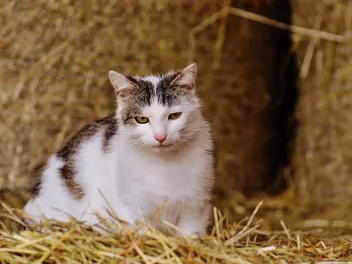
House cats are much smaller than bobcats. They are several inches shorter, as well as many pounds lighter than the wild species. House cats can also come in a variety of shapes and colors, depending upon what breed they are (though they are typically gray, black, brown, orange, or white with different pattern variations). And unlike the bobcat, house cats can be found throughout the world.
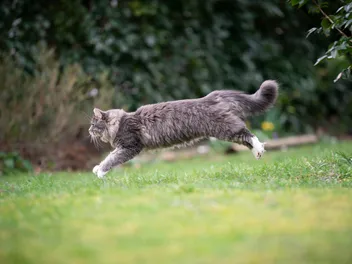
House cats are obligate carnivores that meet their nutritional needs from meat and continue to have that predator instinct inherited from their wild ancestors—making them excellent mousers! The house cat also loves to play and is incredibly fast and agile (when they want to be). They are known for being self-reliant and a bit stand-offish at times (unlike dogs known to be “man’s best friend”), but we still love them!

Noises
As we said, both house cat and bobcat kittens make similar noises, but these begin to sound wildly different as the animals start to age. Instead of the screaming or crying noises a bobcat would make, house cats continue to purr, growl, and hiss, and will primarily meow to get your attention.
Tracks
If you have to depend on tracks to tell you if there’s a house cat or bobcat around, you’ll need to look at the size. This is because all cats walk with the direct register gait, so besides the size and spacing between the tracks, they will look the same. However, a house cat’s tracks will typically be about 1–1.5 inches wide, so they are smaller than those of a bobcat.
What Are the Differences Between Bobcats & House Cats?
Other than the differences in appearance, noises, and tracks mentioned above, in what other ways are bobcats and house cats different?
Population & Distribution
One significant difference between the two cats is how many there are in the world and where they are located.
Bobcats are found in North America, ranging from southern Canada all the way down to central Mexico. They can live in a variety of environments (desert, forests, swamps), so they are fairly spread out. The current estimated population of the bobcat is believed to be between 700,000 and 1.5 million.
When it comes to house cats, they can be found worldwide and in a wide array of environments. And as of recent estimates, there were approximately 370–400 million house cats to be found in the world!
How They’re Treated
Another difference between the bobcat and the house cat is how they’re treated.
Bobcats are legally hunted and harvested for their fur in many provinces in Canada and most states in the U.S. They are also legally hunted in Mexico, though in seemingly smaller numbers. However, being hunted for their fur may not be the most detrimental part of being around humans for the bobcat. Instead, many are affected by habitat loss, vehicle collisions, and human–wildlife conflict, including being killed off by ranchers or farmers.
Clearly, the house cat doesn’t have the issue of being hunted, as it enjoys status as a pet, but they are at risk in other ways. House cats face abandonment in shelters in high numbers (about 3.2 million per year) and are at risk of being euthanized at said shelters if not adopted (around 530,000 per year), though. The best way to prevent those numbers from increasing is to have your pets spayed or neutered.
Which Breed Is Right for You?
Because the bobcat is a wild animal that can’t be domesticated, the house cat is definitely the better choice for you if you’re looking for a pet. Not only will you be able to choose from a variety of breeds, colors, shapes, and patterns, but you also won’t run the risk of being injured (other than perhaps by some sharp claws while playing). Plus, it’s illegal in many jurisdictions to keep wild cats as animals, which isn’t an issue with the house cat.
So, leave the bobcats to their peace out in the wild, and adopt a house cat from a shelter instead!
See Also:
Sources
Featured Image Credit: Left - Laurie E Wilson, Shutterstock | Right - Chamod Lakshitha, Shutterstock
Expert cat care, straight to your inbox
News, insights, and useful advice, delivered to you.

No spam — unsubscribe anytime.
By signing up, you agree to our Terms & Conditions and Privacy & Cookies Policy.
How useful was this post?
Click a star to rate. You can leave written feedback afterwards. (We read all feedback.)
Misty Layne lives out in the woods in small-town Alabama with her two Siamese cats —Serafina and Jasper. She also has an array of stray cats, raccoons, and opossums who like to call her front porch home. When she’s not writing about animals, you’ll find her writing poetry, stories, and film reviews (cats, by far, her favorite writing topic, though!). In her free time, Misty enjoys chilling with her cats, playing piano, watching indie and foreign films, photographing abandoned places, and catching up on her never-ending TBR list.