Get

In Your Inbox

Catster is reader-supported. When you buy via links on our site, we may earn an affiliate commission at no cost to you. Learn more.

Grey Maine Coon: Does It Even Exist?

Share

blue maine coon cat lounging on the chair

Maine Coons are among the world’s largest cats, with the current record holder – a Maine Coon named Ludo – measuring 45.6 inches long from tip to tail. The gentle giants make incredible pets and are available in several coat colors and patterns.

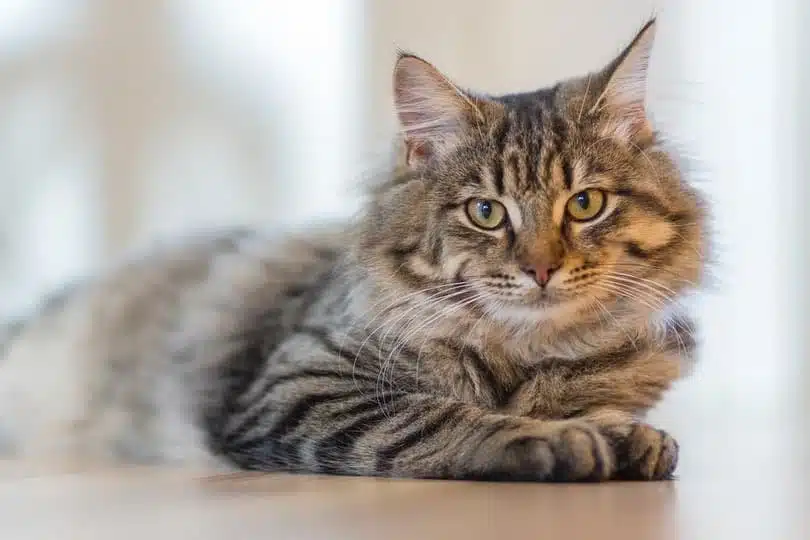
But what about grey? Do grey Maine Coons even exist? To casual observers, there are plenty of Grey Maine Coon cats in the world. Some are grey with hints of silver or smoke. Or even grey with streaks of white fur. And some are just a solid grey color all over.

But…they’re not grey. Well, not at least to the Cat Fanciers Association and other cat clubs. Instead, they’re referred to as “blue”.

divider cat faces oct 2024

How Rare Are Blue Maine Coons?

Maine Coon cats are known to come in over 85 different color combinations.1 With so many different choices, it’s tough to settle on one.

When referring to cat colors, grey or silver cats are called blue due to the bluish tint that their coats will have. The blue is a subtle hue similar to that which military cadets wear. Cats with grey-colored coats effectively have a diluted black coat—genetically speaking.

When it comes to Maine Coon colors, blue is far from the most common. Typical colors for the breed are black, cream, and white. However, solid blue Maine Coons aren’t unheard of. It’s not that rare, but it’s not a popular choice.

But what’s wrong with the term grey? Nobody knows. The running theory is that it just sounds fancier by judges at cat shows.

a blue maine coon cat
Image Credit: Willgard Krause, Pixabay

Understanding The Dilute Gene

A gene known as the dilute gene (or melanophilin) can be present within the genetic sequences of some cats. Not all cats have the gene, and even those who do are not guaranteed to have a diluted coat.

The dilute phenotype—or diluted color coat—only appears when the cat carries two copies of the dilute gene. This is only possible through the inheritance of the gene from both parents, making the effect autosomal recessive and rare.

The effect is produced because the melanophilin alters the distribution of melanin granules (pigment) throughout the cat’s fur. Cats without the dilute gene have normal pigmentation uniformly through the fur. However, cats with two copies of the gene don’t have uniform pigmentation. Instead, they experience pigment clumping that causes many areas in their hair to have no pigmentation at all.

If that’s the case, why are the colors diluted and not absent? The areas of clustering (both with pigment and without) are on a microscopic level. So, when you see them from your eye, the colors appear blended and diluted because we don’t have microscopic vision.

That means when you see a blue Maine Coon, you’re looking at a black cat with two recessive gene copies of melanophilin. Other dilute colors include lilac, which is from chocolate; fawn, which is from cinnamon, and cream, which is from red.

How Can You Tell What Color a Maine Coon Kitten Will Be?

Determining a kitten’s color is pretty easy regarding Maine Coons because of a fascinating set of genetic rules they follow. Male kittens will always obtain both of their color genes from their mother. So, by that logic, male kittens will always be the same color as their mother (or the diluted version).

That means grey male kittens are birthed from black or blue Maine Coon mothers. On the other hand, female kittens receive one color gene from each parent. This makes them more likely to have mixed colors or more unique combinations.

divider cat paws oct 2024

What About Grey vs Silver Tabbies?

A tabby cat is any domestic cat with a pronounced “M” shaped marking on their forehead and any combination of striping, dotting, or other marking along their body. There are also several types of Maine Coon tabby cats.

The five main categories of tabbies are:
  • Classic – These tabbies have the standard “M” marking on their foreheads; however, they exhibit a bullseye-like pattern on each side of their bodies.
  • Mackerel – This is the most common tabby pattern. The pattern displays a dark stripe down the cat’s backbone with other stripes branching down like ribs on a fish skeleton—hence the name.
  • Spotted – These tabby cats are covered in spot-like patches of pigment.
  • Patched – As the name suggests, this coat type features patches of colors, usually gray or brown, that are splattered across the cat’s body.
  • Ticked – Ticked tabbies have fields of agouti hairs, giving the cat a sandy or salt-and-peppered look.

However, you’ll probably hear blue Maine Coons tabbies get separated into silver and gray categories. But what’s the difference? Why is one silver and the other grey?

That has to do with the base color of their agouti hairs. They are the undercoat and ground color hairs of your cat. A tabby with grey/black stripes on top of a grey agouti coat will be referred to as a grey tabby.

If the cats have black or grey stripes/coloring on top of a light/white agouti coat, they’ll be referred to as silver tabbies.

tabby cat patterns
You are free to use this image but we do require you to link back to Catster.com for credit

divider cat faces oct 2024

Conclusion: Grey Maine Coon

Regardless of their coat colors and patterns, Maine Coons make extraordinary pets. Although they’re larger than other breeds, they’re friendly and gentle. While the grey Maine Coon physically exists, they are not formally referred to that way. They’re called “blue” by the professional cat clubs and cat fancy organizations. Grey Maine Coons don’t possess a dominant gene colorway. They’re entirely recessive, but that doesn’t make them any less lovable.


Featured Image Credit: Okeanas, Shutterstock

Want content like this delivered to you?

Sign Up For Our Newsletter

News, insights, expert advice, and everything cat

* By submitting, you agree to our Terms & Conditions and Privacy & Cookies Policy.


How useful was this post?

Click on a star to rate (you can leave written feedback after clicking submit)

Help us improve Catster for pet parents!

Your feedback really matters.

What did you like about this post? Also how can we improve it?

Join the conversation

Leave a Reply

You’re very welcome to leave a comment or question. Please know that all comments must meet our community guidelines, and your email address will NOT be published. Let’s have a positive and constructive conversation.


Catster's Digital Magazine is Back!

Vet-approved health & behavior advice

Real cat stories & community features

Chatting About the Rainbow Bridge, Euthanasia, and Laughter During Grief | Chatty Cattys, Episode 24

If you’ve ever felt the loss of a beloved cat, or are dreading the day when your pet crosses the rainbow bridge, you’ll...

The Simple Reasons Cats Refuse to Let Anyone Use the Bathroom Alone

Cats have an extraordinary talent for making themselves present in the most inconvenient places, and the bathroom ranks near the top of the...

A Paw-sitive Milestone: Canada Officially Becomes a Declaw-Free Nation

Canada has officially become a declaw-free nation. On May 25, 2026, a new regulation was filed in Ontario under the Provincial Animal Welfare...

The Surprisingly Simple Ways to Help a Cat With Hairballs

Cats spend an astonishing amount of time grooming. It is part hygiene routine, part comfort ritual, and part instinct that traces back generations....

More related

The Joys of Sharing My Office With Cats: Litter in the Keyboard & More

Hi, I’m Dr. Karyn! Read my introduction to learn more about me and meet my five hilarious cats: Clutch, Cyril, Alex, Zelda, and...

Is It True That All Stray Cats Have Fleas? Vet-Verified Facts & FAQ

It is fair to assume that all stray cats have fleas simply because they are more likely to be exposed to other animals...

What Causes Chronic Diarrhea in Rescue Cats? 8 Vet-Verified Causes & Solutions

Rescue cats can make a wonderful addition to your family, because they are the most in need and often return the favor by...

10 Best Ear Mite Treatment for Cats in 2026 – Reviews & Top Picks

If you’re watching your cat scratching their ears obsessively and continuously shaking their head, they might have ear mites. While they aren’t terribly...

Keep reading

That Crusty Red Spot on Your Cat’s Lip Isn’t What You Think

You’re petting your cat when your thumb brushes something rough on their lip. You pull back to look, and there it is: a raised, reddish patch that definitely wasn’t there last week. Your stomach drops a little. What is that?...

veterinarian checking the mouth of cat

Why Is My Cat Drooling Thick Saliva? 12 Vet-Reviewed Reasons & Treatment

Cats are fascinating creatures, often leaving us in awe with their peculiar habits and quirky behaviors. However, as a cat owner, you might be alarmed to see thick saliva dripping from your feline’s mouth, making you wonder if it’s a...

Orange cat drooling

Do Cats Blink Like Humans Do? Vet-Reviewed Facts & FAQ

Cats are fascinating creatures to observe. We could watch them and ponder their various distinctly feline behaviors endlessly. Their fantastic array of eye movements is hugely expressive, making us certain of what they are communicating—either to you or to another...

close up dilute calico norwegian forest cat with eyes closed

Do Cats Have a Clitoris? Feline Reproduction Facts & FAQ

If you’ve ever wondered if female cats have clitorises, the answer is yes; it’s an anatomical part shared by all female mammals! Fetuses all start with a structure called the genital tubercle that becomes a penis when exposed to fetal...

Curious cat

4 Best Foods for Cats With Feline Leukemia in 2026 – Reviews & Top Picks

Feline leukemia is an infectious virus that affects your cat’s immune system and is transmitted to other cats through their saliva, feces, or urine. Some cats infected with feline leukemia will have the disease for life, and unfortunately, there is...

orange cat eating on an orange bowl

Arthritis in Cats – Vet Approved Causes, Signs & Treatments

If your cat seems a little less sprightly and active than usual, it can be a cause for concern. Some health issues could cause mobility issues in cats, but one condition fairly common in mature cats is arthritis. Arthritis can...

cat lying on wooden floor

What Are E-Collars for Cats? Vet-Reviewed Types, Pros, Cons & FAQ

You may not immediately recognize the term “e-collar,” but you’ve definitely heard of them. You might know the e-collar by its more affectionately referred to term: the Cone of Shame. E-collars, or Elizabethan collars, as they’re more officially known, is...

cat wearing an ecollar

Scottish Fold Cat Health Problems: 7 Vet-Reviewed Issues

Scottish Fold cats have found their way into many pet lovers’ hearts with their unique folded ears and sweet personalities. As with any breed of cat, the Scottish Fold cat has its own set of health issues you need to...

Catster_Health Problems of Scottish Fold

Love Cats? So Do We! Join the Catster Community

Stay informed with expert pet care insights delivered straight to your inbox! Discover professional guidance on animal behavior, feeding tips, trusted product picks, and much more.


Sign up for the Catster Email Newsletter

Stay informed with expert pet care insights delivered straight to your inbox! Discover professional guidance on animal behavior, feeding tips, trusted product picks, and much more.