Get

In Your Inbox

Catster is reader-supported. When you buy via links on our site, we may earn an affiliate commission at no cost to you. Learn more.

Is Cedar Poisonous to Cats? Vet Approved Facts & FAQ

Share

Catster_Is Cedar Poisonous to Cats

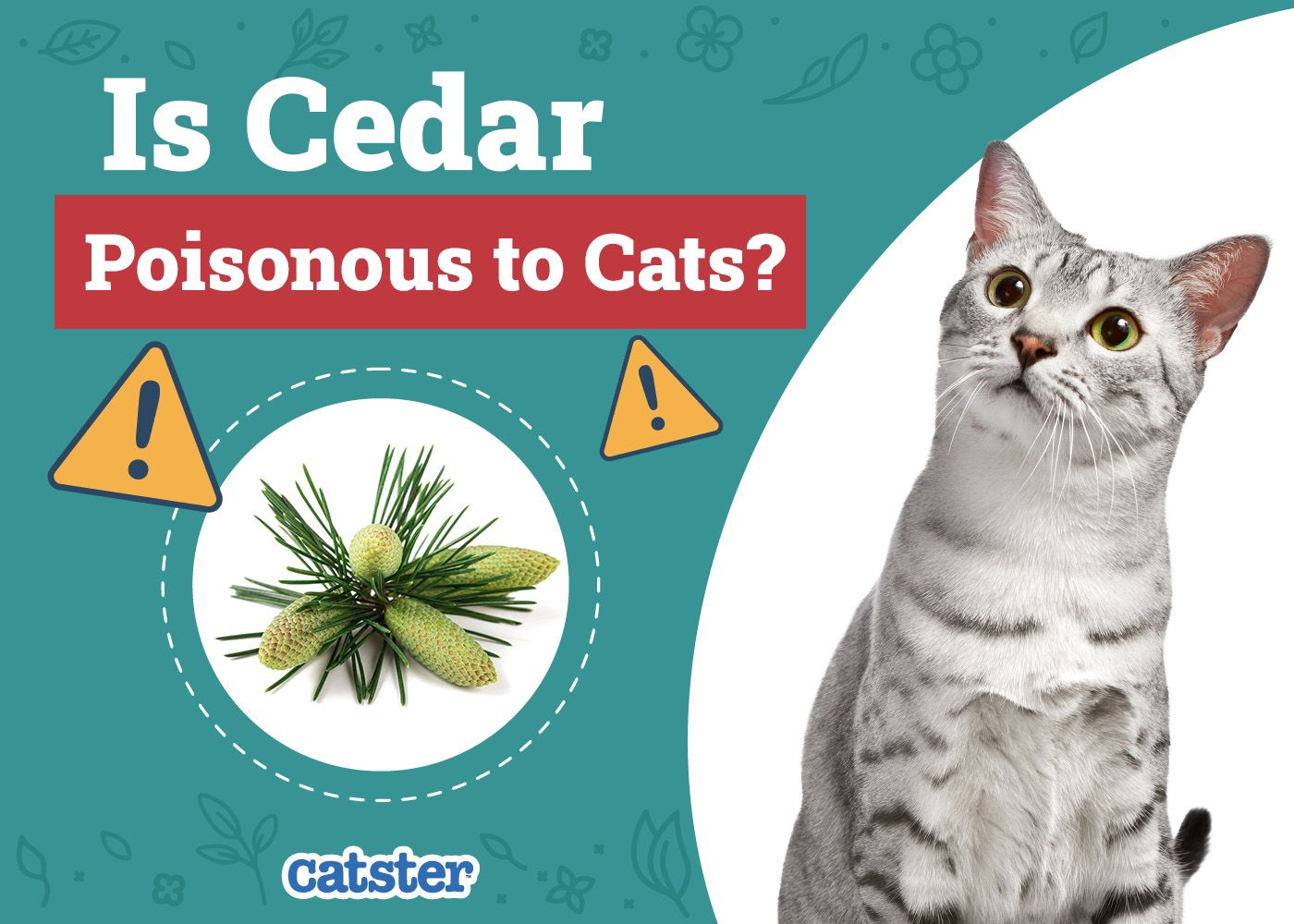
Any loving cat parent wants a heads-up as to which substances or plants can be poisonous to felines. If you’re wondering whether cedar trees are toxic to cats, unfortunately, yes, cedar can be poisonous to cats—some cedar trees are, in fact, highly toxic to cats. In this post, we’ll explore which cedar trees are poisonous to cats and why this is the case.

divider single cat paw oct 2024

About Cedar Trees

Cedar trees are coniferous trees of which there are only four true types—Cedrus atlantica, Cedrus brevifolia, Cedrus deodara, and Cedrus libani. They’re native to the Himalayas and Mediterranean countries, and, though there are plenty of ornamental cedars in the US, true cedars are not native to North America. These trees are not listed by the ASPCA as being toxic to cats.

Cedar trees are tall with huge trunks, needles, and a very distinctive, specific scent that can be described as fresh, spicy, and somewhat citrusy. For this reason, cedar is sometimes used in essential oils and candles.

Are Cedar Trees Toxic to Cats?

This is where things can get confusing. There are many types of trees from other plant families that are known as cedars and yes, some false cedar varieties are highly toxic to cats. One of the most toxic cedars is white cedar—Melia azedarach (also known as bead tree, chinaberry tree, paradise tree, and Persian lilac among other names), which, according to the ASPCA, is toxic to cats, dogs, and horses and can cause symptoms like drooling, vomiting, diarrhea, and seizures.1

White cedar contains tetranortriterpenes (meliatoxins), a chemical compound toxic to cats. The most toxic parts of white cedar trees are the berries, however, the leaves, flowers, and bark are also toxic.

Another false cedar tree toxic to cats is the Eastern red cedar-Juniperus virginiana, which has poisonous bark, berries, and needles. The Western red cedar—Thuja plicata, can also cause adverse effects in cats but is less dangerous than the Eastern red cedar. These trees are toxic due to the presence of phenols and terpenes.

Though some cedar trees may only cause mild adverse effects like an upset stomach, it’s still a good idea to keep your cat away from cedars just to be safe—especially if your cat is in the habit of pulling bark off trees or nibbling on the fruit or needles that fall from them of if you’re not 100% certain the tree in question is of the safe variety.

sick grey tabby cat
Image Credit: chie hidaka, Shutterstock

What About Cedar Essential Oils?

Many cedar essential oils are formulated without phenols and instead contain non-toxic ingredients. These are usually considered to be safe to use around cats. That said, the ASPCA advises that essential oils in 100% concentrated form can be incredibly dangerous to pets. The ASPCA also points out that essential oils come in various concentrations and contain such a wide variety of ingredients that it’s difficult to ascertain the toxicity levels of different essential oils.

Furthermore, never put essential oils on your cat’s fur or skin or allow them access to the oils. If you have cats it may be best to avoid essential oils altogether.

My Cat Ate Cedar, What Should I Do?

If you suspect that your cat has ingested cedar of any variety or they’re displaying symptoms of poisoning like vomiting, salivating, diarrhea, and difficulty breathing, please contact your vet or pet poison hotline straight away.

If your cat has vomited and you see a piece of the cedar or toxic plant your cat has consumed, keep it to show your vet. This will help your vet identify the plant or tree and therefore speed up diagnosis and treatment.

Try to stay calm—just because a cat has consumed part of a cedar tree does not guarantee that they will become seriously unwell. However, the quicker you act, the quicker your cat gets treatment if they have eaten something toxic.

divider single cat paw oct 2024

Conclusion

To sum up, there are many different kinds of trees with cedar in the name and most are not true cedars from the Cedrus family. Some cedar tree varieties typically cause mild effects if ingested, whereas others—like the white cedar tree and the Eastern red cedar—are more toxic in nature.

For this reason, it’s best to exercise caution when it comes to cedar trees just to be on the safe side. If you suspect your cat has consumed part of a cedar tree, please contact your vet or pet poison hotline to find out the next steps.


Featured Image Credit: Nadya So, Shutterstock

Want content like this delivered to you?

Sign Up For Our Newsletter

News, insights, expert advice, and everything cat

* By submitting, you agree to our Terms & Conditions and Privacy & Cookies Policy.


How useful was this post?

Click on a star to rate (you can leave written feedback after clicking submit)

Help us improve Catster for pet parents!

Your feedback really matters.

What did you like about this post? Also how can we improve it?

Join the conversation

6 Responses

    1. Hey Lori since your cats sleep in your bedroom, you should exercise extra caution when using cedar. While solid cedar blocks or panels are generally acceptable in drawers and closets where the scent remains mild, you should strictly avoid strong cedar sachets or concentrated oils in areas where your pets spend several hours resting. It is best to keep cedar items enclosed within storage spaces rather than out in the open, and you should ensure the room stays well-ventilated while monitoring your cats for any respiratory irritation like sneezing. If your cats frequently nap near your clothes or inside your closet, it is safest to use cedar very sparingly or opt for a different alternative entirely.

  1. building a cat shelter can western red cedar boards be used on the outside of shelter, the interu=ior will be isolated from the cedar boards by insulation and interior walls

    1. Hi John. Western Red Cedar contains natural oils (thujaplicin, plicatic acid) that irritate cats' respiratory, skin, and digestive systems. For cat safety, cedar must be completely sealed, with no exposed surfaces. Avoid cedar shavings/bedding. If building a cat shelter, use sealed, kiln-dried cedar only on the exterior, insulate with non-toxic materials, and finish the interior with smooth, safe, easy-to-clean walls (formaldehyde-free plywood/plastic paneling) and washable bedding. We hope this helps.

    1. Hi Ava, while it is unlikely that the Cedarific cat litter contains wood from the toxic types of cedar, it could be risky to use it. That said, we recommend contacting them directly for more details as we are unfamiliar with the brand.

Leave a Reply

You’re very welcome to leave a comment or question. Please know that all comments must meet our community guidelines, and your email address will NOT be published. Let’s have a positive and constructive conversation.


Catster's Digital Magazine is Back!

Vet-approved health & behavior advice

Real cat stories & community features

Chatting About the Importance of Spaying/Neutering, Cat Retail Shopping Ban & Red-Level Storms | Chatty Cattys, Episode 30

In this episode of Catster’s Chatty Cattys podcast, Nicole and Dr. Karyn are celebrating a major legal win for pets before diving into...

Is Your Cat Happy? Here’s How You Can Tell

Cats have a reputation for being indifferent, even inscrutable. But despite their seemingly ambivalent appearance, cats experience many emotions, including happiness, and they...

Human Brains Age Like Cats – New Study Debunks the 7-Year Rule

If you’ve ever caught your senior cat staring blankly at a wall, wandering the halls at 3 am, calling out for no clear...

Chatting with Devin About Here! Have a Kitten, Fostering, & Why Two Are Better Than One | Chatty Cattys, Episode 29

In this episode of Catster’s Chatty Cattys podcast, Nicole & Dr. Karyn sit down with Devin, the founder and one-woman show behind “Here...

More related

How Do Cats Get Worms? Vet Reviewed Causes, Signs & Prevention

Finding worms in your favorite feline’s poop or around their butt is never pleasant. But it is not uncommon for our pets to...

Why Does My Cat Go into Another Room and Meow? 9 Vet-Reviewed Reasons

Cats meow as a means of communication with others, with us, and to express their internal states, which can make us think that...

How to Use Cat Nail Clippers: 4 Vet-Approved Steps

Devoted cat parents go above and beyond to create comfortable environments for their felines and ensure their furry friends are always well-fed and...

Litter Robot 4 Review 2026: How It Measured Up in My Multi-Cat Home

Litter-Robot gives you the upper hand on cleaning cat litter. As a matter of fact, the Litter-Robot 4 takes your hands entirely out...

Keep reading

Vitamin B12 for Cats: 7 Vet-Approved Food Sources

Vitamin B12, or cobalamin, is an essential nutrient for cats, having a vital role in multiple key body functions and processes. Cats cannot produce B12 and must get it from their food instead. Keep reading to learn about great food...

cat eating food in the bowl

Can Cats Eat Prosciutto? Vet-Approved Nutritional Advice & FAQ

One might not think cats would be beggars like dogs when it comes to our food, but they can be! If your cat is constantly up in your meals, trying to get a taste of what they’re sure is delicious,...

Can Cats Eat Prosciutto

Can Cats Eat Tomato Sauce? Vet-Reviewed Nutrition & Safety Guide

It’s dinner time, and you’re serving up your signature dish of spaghetti with jarred tomato sauce because who has time to make tomato sauce from scratch? A dollop of sauce accidentally hits the floor, and your cat, waiting patiently by...

Can Cats Eat Tomato Sauce

Raw Food Diet for Cats: Vet-Approved Pros & Cons

Choosing the proper diet for your cat is an incredibly difficult decision. You must balance your desire to give your cat what’s best and consider their finicky nature. Time and effort are also big considerations. Raw pet food is all...

raw cat food

How to Make Dry Cat Foods Soft: 6 Vet-Approved Methods That Work

Some owners prefer to feed their cats dry food, whether as a solitary source of food or in addition to wet food meals. Because kibble is dehydrated, cats on a kibble diet should be drinking water to prevent dehydration. However,...

orange cat eating wet food

How to Tell If Your Cat Loves You: 12 Vet-Reviewed Signs to Look For

Cats have an unfair reputation as aloof independent creatures that don’t need us humans—unless they’re hungry. While some cats can be self-contained, others are incredibly outgoing when it comes to letting their owners know that they love them. Whichever side...

boy-falls-asleep-and-hugs-his-cat-who-sleeps-with-him-under-the-covers

6 Best Top-Entry Litter Boxes in 2026 – Reviews & Top Picks

Top-entry litter boxes are aesthetically pleasing and fit in with modern décor more than standard litter trays. They’re tall and hygienic and help keep your house clean from lumps of kitty litter stuck to your feline’s paws. These litter boxes...

ginger cat inside red grey enclosed litter box

10 Best Flea Sprays for Cats (2026) – Reviews & Top Picks

Fleas can be irritating at the best of times, but if left untreated, they can cause discomfort and even lead to your cat developing flea allergy dermatitis. At the first sign of fleas, it’s a great idea to treat your...

Cat-with-fleas

Love Cats? So Do We! Join the Catster Community

Stay informed with expert pet care insights delivered straight to your inbox! Discover professional guidance on animal behavior, feeding tips, trusted product picks, and much more.


Sign up for the Catster Email Newsletter

Stay informed with expert pet care insights delivered straight to your inbox! Discover professional guidance on animal behavior, feeding tips, trusted product picks, and much more.