How to Switch Cat Foods: Vet Approved Tips for Transitioning Your Cat’s Diet


In this article
Whether it’s because you think that your cat’s current food is no longer appropriate for them, it’s become impossible to find, or your pet simply refuses to eat it anymore, sometimes you have to switch your cat to a new brand.
It sounds simple. All you have to do is buy a different food, right?
As it turns out, it’s somewhat complicated. Here, we show you exactly how to transition your cat to their new food with as little fuss and muss as possible.

Do You Have to Transition at All?
Humans love variety when they eat. If we didn’t, there would be far fewer restaurants and grocery stores would only need two or three aisles to sell everything suitable for our consumption.
It’s easy, then, to assume that our pets are the same way. Cats, however, are generally perfectly happy to eat the same thing day in and day out (assuming that they like it, of course), and their bodies get accustomed to that regularity.
There are several theories as to why cats don’t seem to mind monotony with their diets. For starters, cats seem content with eating the same food repeatedly because they have fewer taste buds than humans do; therefore, flavor is likely not as important a factor for them. In addition, cats lack the ability to taste sweet things; however, they can taste amino acids and, therefore, seem to prefer higher protein foods consistently. Finally, unlike dogs, cats lack a strong social component to their diet and seem content eating the same thing on their own.
If you make a massive change to their diet without warning, it can throw off their entire digestive tract. This includes disrupting their gut flora, which are beneficial bacteria that help with everything from digestion to boosting their immune systems. That could lead to vomiting, diarrhea, and a refusal to eat—none of which you want to deal with.
The refusal to eat may sound like the best scenario of the three, but it’s not: A sudden refusal to eat that lasts for longer than 24–48 hours could lead to fatty liver disease, a condition that requires prompt veterinary intervention. It’s extremely important, then, to make the transition slowly and handle it with care.

Make the Change for the Right Reasons
There are several reasons why you would have to transition your cat’s diet.
Situations Where Dietary Changes Might Be Necessary
Please note that, as a general rule of thumb, if your cat suddenly seems to be refusing their food while having not done so in the past, your priority should be to have a veterinarian thoroughly examine them, as this can often be a result of an underlying medical issue.
You should use this opportunity to switch them to the healthiest food that you can afford (and that they’ll eat). Switching foods is something that you may only do a few times in your cat’s life, so you should try to give them the healthiest diet that you can as soon as you can.
Take It Slow
Now, let’s look at the proper way to transition them to a new food.
The whole process should take around 7-10 days at a minimum. In some cases, you may need to take longer than that, especially if your cat is a finicky eater or has preexisting digestive issues. In rare cases, the transition could take as long as a month, but that’s typically only for cats with serious stomach problems or other health issues (as always, talk to a vet before changing your cat’s diet).
You should start by mixing a little bit of the new food in with the old. The first day should be about 5%–10% new food and 90%–95% old food—do this for all meals if you feed your cat multiple times a day.
During this process, keep track of your cat’s appetite and litter box habits. You’d want to note if they’re using the litter box at the same frequency as before or if the duration seems to have increased or decreased. Also, keep track of their poop as well. If they seem constipated or if they appear to have diarrhea, these are things you’d want to take note of. As this can be time-consuming, it’s sometimes beneficial to use technology to help you do so (such as your CCTV or a webcam).
Additionally, you should keep track of your cat’s antics, particularly right after they’ve eaten. If you observe your cat retching, regurgitating whatever it is they ate, or vomiting, take note of these incidents.
All of the abnormal incidences warrant stopping the transition and having your cat looked over by your vet because it indicates that their body isn’t adjusting to their new diet well. Other subtle cues that your cat’s body might not be too accepting of their new diet is if you notice your cat’s fur suddenly shedding more than usual or if you notice your cat over-grooming themselves. However, please be mindful of the fact that it is perfectly normal for cats to groom themselves right after a meal, and, therefore, you’d have to gauge this response with caution.
If your cat seems to be doing well with the initial food composition, gradually increase the amount of new food every other day by 5%–10% while simultaneously reducing the amount of their old food by the same amount.
Eventually, repeating this pattern while keeping a watchful eye on your cat’s digestive health will get you to a point where the two foods are of the same proportion, until eventually, the new food becomes the majority of your cat’s intake until you’re feeding them the new stuff entirely. This should take at least around 10 days or so, but you can drag it on a bit longer than that if you want to make absolutely certain that there won’t be any issues.
Please note that throughout the entire process, you should offer your cat an unlimited amount of fresh, clean drinking water at all times. If your cat is being transitioned from a dry diet to a fresh or moist diet, you might note that their water intake eventually reduces a bit, as such foods provide hydration to an extent. Conversely, if your cat is being transitioned to dry food, you’ll notice that their water intake increases.

What Problems Could You Encounter Along the Way?
Assuming that you transition your cat slowly and steadily, there shouldn’t be a problem. However, if you try to go too fast, your cat may suffer from digestive issues.
As mentioned previously, if your cat starts vomiting, has runny stools, or stops eating entirely, you should stop the transition process and take them to the veterinarian. You may re-attempt a transition after your veterinarian has checked your cat. Your veterinarian may also prescribe or suggest a different diet for your cat to transition to.
Sometimes, your cat won’t even try the new food. Generally speaking, this often warrants trying something new, as cats can be picky eaters. Anecdotally, using substances like food toppers might entice your cat to have a bite of their new food; however, these are additional calories and expenses you’ll have to factor into your cat’s nutritional life.
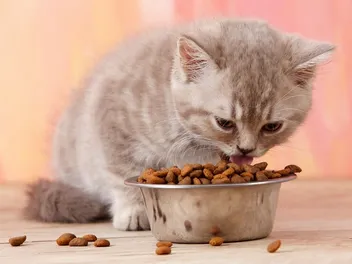
A young kitten who doesn’t realize food is “food” can sometimes be enticed to try something by placing a small amount of food just under their nose, prompting them to lick it. Doing so introduces them to the taste of the food.

Final Thoughts
If you’re ready to switch your cat to a new food, following these steps will help you do so without having to clean up any messes (or put your cat’s health at risk) along the way.
Luckily, making a change in your cat’s diet is fairly simple and painless; as long as you’re not impatient, you shouldn’t have too many issues.
Featured Image Credit: Nom nom

Expert cat care, straight to your inbox
Vet-reviewed advice, behavior tips, and the best of Catster. Free, and you can unsubscribe anytime.
By signing up, you agree to our Terms & Conditions and Privacy & Cookies Policy.
Quincy never intended to be a cat person. He grew up around dogs, and when his wife brought home a kitten one day, he told her she had one week to find it a new home. That week turned into 10 years (his wife moves very slowly), and that kitten turned into three (they got two more, the kitten didn't self-replicate). After a decade of sharing his home with three cats, one horrifying realization finally set in: oh God, he's a cat person now, isn't he???
Join the conversation
Ask a question, share your story, or send private feedback.