Breast Cancer in Cats: Signs, Causes & Care (Vet Answer)

In this article
Have you found a swelling on your cat's belly and aren't sure what it is? Maybe your veterinarian has found a mass as part of your cat's routine physical exam before getting a rabies vaccine. Regardless of how the lump was found, what does it mean if your car has a mammary mass?

What Is Breast Cancer in Cats?
While we call it breast cancer in people, we usually refer to it as mammary cancer in our pets. Cats have chains of (usually) four mammary glands on either side of their belly. Nodules or growths can develop in this tissue. Cancer is an abnormal pattern of cell division and replication.
Mammary tumors in cats are almost always malignant, with an estimated 80% to 96% of cases in cats being malignant tumors.1 The remaining ones are benign. The difference is that malignant tumors tend to spread and are often more aggressive in their growth.
Most cases of mammary cancer in cats occur in intact female cats. They can develop in spayed females or even male cats, although that's a rarity.
There are several significant types of mammary cancer in cats, with the most common being adenocarcinomas. Other types of this cancer or growths are:
- Sarcoma
- Duct papilloma
- Mucinous carcinoma
- Adenoma
- Adenosquamous carcinoma
- Fibroepithelial hyperplasia
- Lobular hyperplasia

What Are the Signs of Breast Cancer in Cats?
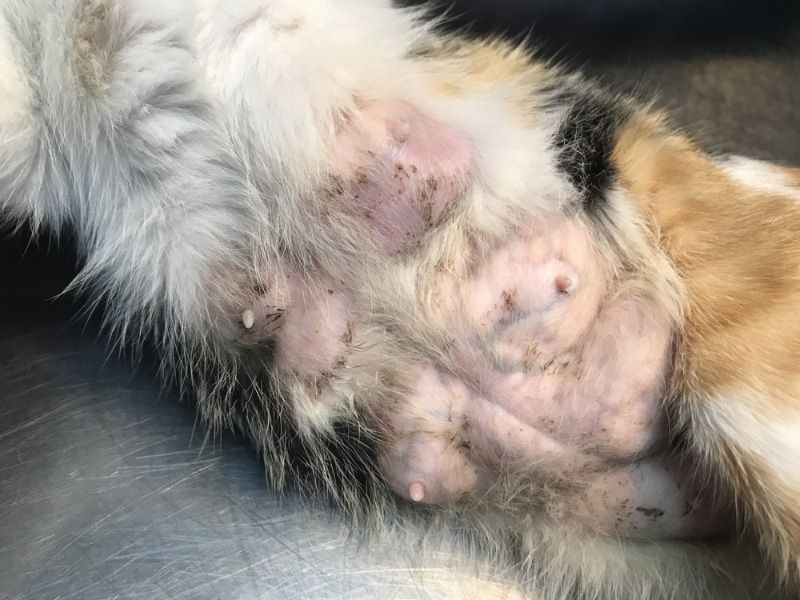
Initially, you might notice a slight swelling on your cat's belly associated with a mammary gland. Sometimes, they have more than one, especially if they haven't been detected for a while.
There's no one way to describe the masses. They can be nodular or lobular. There can be multiples. They generally follow the mammary gland or are associated with the nipple. Sometimes, the tissue overlying the mass becomes friable and can become ulcerated. In extreme cases, the mass and surrounding tissue can become necrotic.
Malignant cancers tend to spread, so you may also see signs associated with cancer in other areas:
- Lethargy
- Lack of appetite
- Weight loss
- Coughing
- Increased respiratory rate
What Are the Causes of Mammary Cancer in Cats?
While we don't know the exact cause of mammary cancer in cats in many cases, there appears to be a clear association with reproductive hormones, estrogen, and progesterone. The general theory is that the hormones enlarge mammary cells, which can eventually progress to cancer.
Unspayed female cats are at a significantly higher risk of developing mammary cancer, with as much as a seven-fold increase in the probability of developing these tumors. Cats that are spayed young have a decreased risk of developing mammary cancer. Here are some statistics that support this fact:
- With surgery done before six months of age, your kitty's risk of developing a mammary mass is less than 10%.
- The risk increases to 14% of cats spayed between 7 and 12 months old.
There appear to be several risk factors for cats developing mammary tumors:
- Obese or overweight cats may be more likely to develop them.
- Certain breeds are predisposed, including Siamese and Persians.
- Most cats that develop mammary tumors are considered middle-aged: between 10 and 12 years old.

How Do I Care for a Cat With Mammary Tumors?
If you notice a lump near your cat's mammary glands, you should have your kitty evaluated by a veterinarian as soon as possible. Your veterinarian will palpate your cat's abdomen and lymph nodes, looking for changes.
They will likely suggest cytology or a fine needle aspirate (FNA). Your veterinarian will stick a needle into the lump and collect a sample of cells. They may examine it in the hospital or send it to a pathologist. Because most feline mammary cancers are malignant and can metastasize, your veterinarian will likely recommend blood work and staging X-rays to look for cancer spread.
Surgical removal is usually the starting point for treatment. Depending on the location and size of the mass or masses, your veterinarian may recommend a mastectomy of the affected gland, a chain mastectomy on the affected side, or a radical bilateral mastectomy, removing both mammary chains. They may sample local lymph nodes or remove them to evaluate for cancer spread.
Your cat must rest after surgery, usually for 10 to 14 days. They should wear an Elizabethan collar to keep them from licking at their incision. Your cat will usually need suture removal at the end of their recovery period.
Your veterinarian is likely to recommend chemotherapy or an oncology consult after surgery or even before surgery if it looks like the cancer has spread. The most commonly used chemotherapy agents in these cases are:
- Cyclophosphamide
- Doxorubicin
- Carbonation
Chemotherapy protocols vary but usually last for several cycles at intervals of 3 to 4 weeks. Chemo in cats is usually well tolerated, with the most common side effects being lower than normal white blood cell counts and a lack of appetite.

Frequently Asked Questions (FAQ)
Can you prevent mammary cancer in cats?
By spaying your cat early, you significantly decrease the possibility of mammary cancer developing. That said, even male cats can develop mammary cancer. Monitor your cat closely, especially if they were spayed later in life. Check their abdomen regularly for new lumps or bumps and make an appointment with your vet if you notice anything unusual.
What is the prognosis for cats with mammary cancer?
If aggressive surgical removal of entire mammary chains is not performed, there is a high chance (66%) of recurrence of the mass. The masses' behavior and size also help determine a cat's prognosis. Cats with a larger mass may only survive for a few months, while cats diagnosed early have the mass removed while under 2 centimeters have a survival time of over three years.

Conclusion
Getting the diagnosis that your cat has mammary cancer is scary, especially since most cases in cats are malignant. Early diagnosis and treatment are vital to increasing survival times. If you have a young female cat, getting them spayed is the best way to reduce the chance of mammary cancer risk.
Sources
Featured Image Credit: M. Sam, Shutterstock
Expert cat care, straight to your inbox
News, insights, and useful advice, delivered to you.

No spam — unsubscribe anytime.
By signing up, you agree to our Terms & Conditions and Privacy & Cookies Policy.
How useful was this post?
Click a star to rate. You can leave written feedback afterwards. (We read all feedback.)
Dr. Samantha Devine DVM (Veterinarian)
Samantha Devine is a practicing veterinarian who loves to share her experience with animal species and their health. Whether it's a guinea pig question or a pressing matter about something your cat ingested, she strives to provide clear answers. She is passionate about preventative care and firmly believes in the old adage, "An ounce of prevention is worth a pound of cure."
Dr. Devine has been practicing veterinary medicine for over 12 years and has spent a great deal of that time writing online to educate pet owners. In addition to general practice small animal medicine, she has worked with horses. zoo animals and aquatic species. She enjoys all aspects of preventative medicine, from nutrition to vaccines.
Dr. Devine received her degree from the Virginia Maryland Regional College of Veterinary Medicine.